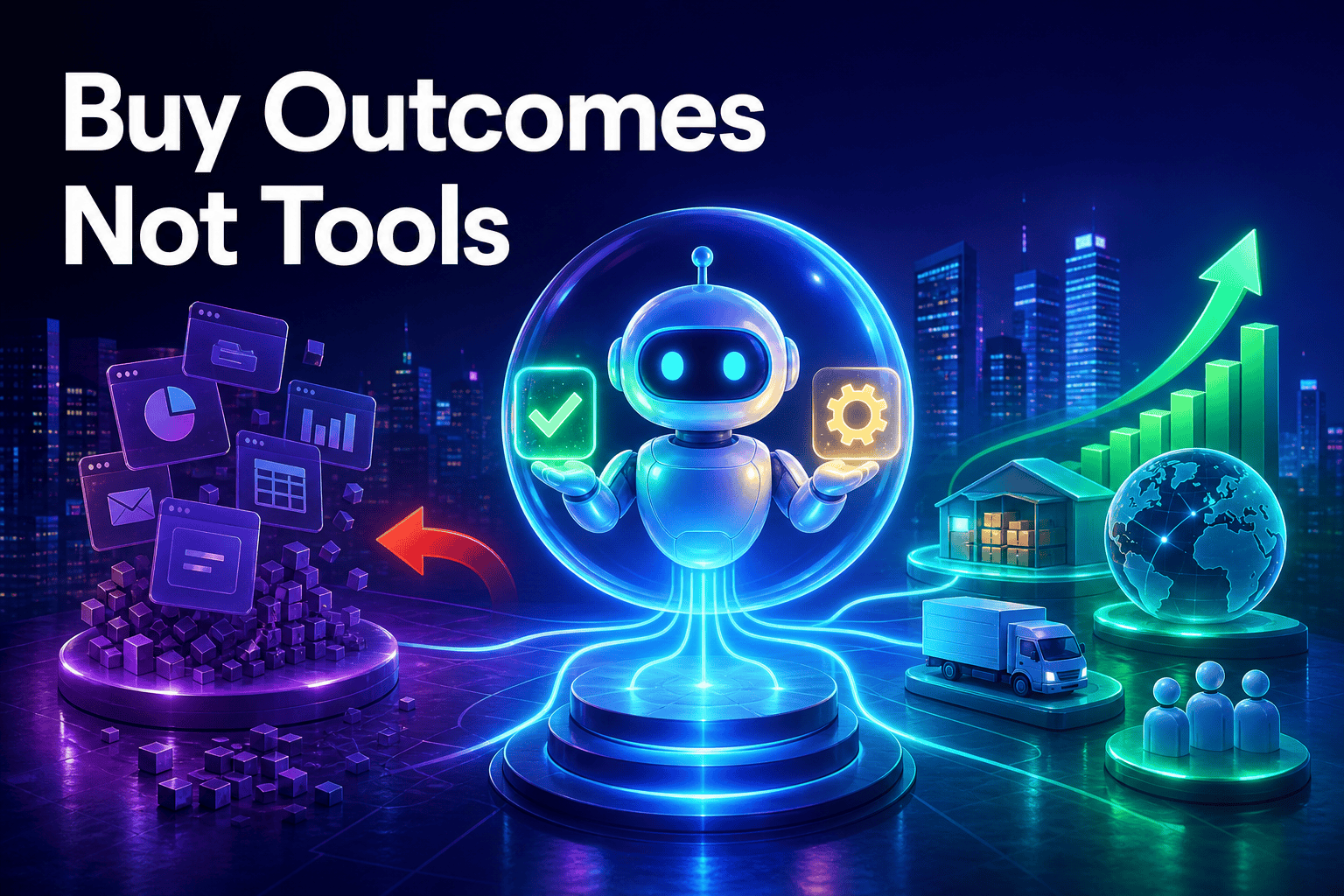
FourKites has introduced an Outcome-as-a-Service model for supply chain operations, built around AI agents that automate logistics and workflow tasks. On October 19, the company said it wants customers to buy measurable business results rather than just software access.
That matters well beyond logistics. For owners and operators, the important signal is that ai agents for business are being positioned less as assistants and more as systems tied to business outcomes.
What FourKites actually announced
FourKites says each customer engagement will now start with a defined target, such as improving on-time-in-full delivery, reducing expedited freight spend, or lowering the cost of serving customers. From there, the company identifies the data, workflows, and AI agents needed to support that result.
This is a different pitch from the usual software model. Instead of asking a customer to adopt another dashboard or another workflow tool, FourKites is framing the sale around completed operational work and measurable performance improvement. The product story shifts from tool usage to outcome delivery.
| Signal from the announcement | What FourKites said | Why it matters |
|---|---|---|
| Supply-chain tool sprawl | Large enterprises often use 10 to 15 separate tools | More tools do not automatically create a better result |
| Long-term ambition | One billion hours of operational work completed over the next decade | The company is positioning AI agents as a real execution layer |
| Operating context | Network graph connects 1,600+ brands, 500,000 carriers, and 3.6 million facilities in 176 countries | Context-rich data is central to useful agent decisions |
| Predefined use cases | New website shows 70+ business outcomes and related AI agents | Buyers are being guided toward outcomes, not features |
| Scale of data flow | More than 3.2 million supply-chain events processed daily | Reliable automation depends on steady operational signals |
The company also says it has reworked its own internal operations around AI-led execution, including automation in engineering that moved releases from fortnightly cycles to daily continuous releases. That detail is useful because it shows FourKites is not only selling the idea externally; it is organizing itself around it internally as well.
Why this is bigger than a supply-chain update
A lot of software is still bought tool-first. A business chooses a platform, rolls it out, and only later tries to connect it to revenue, cost, service quality, or throughput. FourKites is pushing the opposite logic: start with the business goal, then assign software, data, and agents to that goal.
This is where many AI projects stall. They add clever features, but they do not redesign the work itself. A team ends up with more screens, more alerts, and more experiments, yet the same people still do the same repetitive coordination behind the scenes.
Even outside supply chain, the pattern is familiar. A small business might have separate tools for website chat, CRM notes, support requests, task tracking, and reporting. The hidden problem is not just too many tools; it is that nobody owns the whole outcome from first signal to completed action.
The real shift is simple: stop asking whether you need another AI feature, and start asking which business outcome should have an AI owner.
AI agent vs chatbot: why action matters
The FourKites announcement is also a good way to understand the ai agent vs chatbot debate. A chatbot mainly answers questions. An agent becomes valuable when it can use context, make a decision, and trigger work across a process.
According to FourKites, its agents use live network information about carriers, ports, and receiving facilities to act on behalf of customers, then improve from previous results over time. That is much closer to ai employees handling slices of operational work than to a simple FAQ layer.
For an SMB, the lesson is not to copy enterprise logistics. The lesson is that the best AI systems are not just conversational. They are connected to real workflows and can reduce the repetitive work where a human currently spends time moving information from one system to another.
What smaller businesses can copy right now
You do not need a global supply-chain network to use this approach. Start with one repeated workflow, one measurable outcome, and the minimum data needed to support it. AI automation for small business works best when the target is narrow enough to measure and common enough to matter every week.
- Pick one outcome first: faster lead response, cleaner support triage, fewer missed follow-ups, or better task visibility.
- List the steps a person repeats every day or every week.
- Separate those steps into conversation, lookup, and action.
- Connect the tools the agent needs so it can do more than just answer questions.
This is where an ai agent platform can be practical for smaller teams. For example, botb2b.ai offers an AI front desk for your website chat widget and Telegram, a free CRM with task boards, a catalog of AI models, and mcp servers that help assistants like Claude and ChatGPT work with business tools without hiring a developer.
If you are exploring the model context protocol, keep the question simple: can your assistant access the right business context and use it inside the tools your team already depends on? That matters more than whether the interface looks advanced.
What this means for your business
This is useful ai news for business because it shows where the market is going. Buyers are becoming less interested in isolated AI features and more interested in accountable automation that is tied to a real outcome.
If you are evaluating AI right now, a practical checklist looks like this:
- Choose one outcome before you choose a tool.
- Prefer systems that can take action, not only generate text.
- Make sure the agent has enough context from your CRM, knowledge base, or workflow tools.
- Measure whether the work gets completed more smoothly, not whether the dashboard looks impressive.
You do not need an enterprise control tower to benefit from this shift. But you should pay attention to the buying logic behind it. The next wave of winners will not be the businesses running the most AI experiments; they will be the ones that assign real operational work to the right ai agents for business.