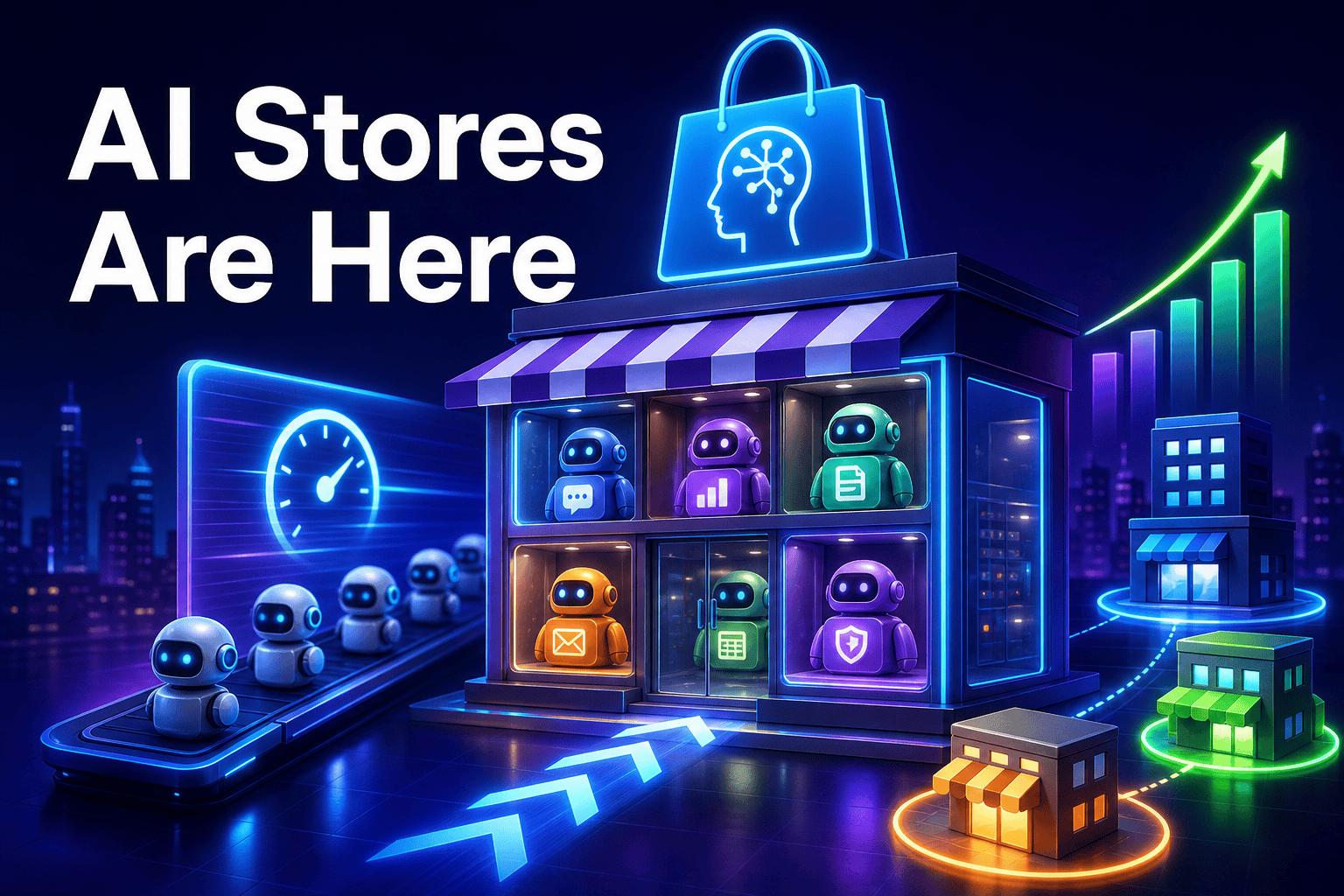
Insight has launched an online Agent Store for business customers, now generally available in 14 countries. On the surface, this looks like another enterprise AI launch. In practice, it points to a more useful shift: businesses are starting to buy AI agents for business in a marketplace-style format instead of treating every use case like a custom consulting project.
That matters because most owners are not short on AI ideas. They are short on time, internal bandwidth, and clear implementation paths. When a vendor packages narrow, practical agents for quoting, legal review, training, or cost control, it becomes easier to move from curiosity to day-to-day use.
What Insight actually launched
Insight’s new store is an online marketplace for AI agents for business, designed for enterprise buyers but relevant well beyond that segment. According to the announcement, customers can browse a catalogue of agents, platforms, and related services and deploy them in days or weeks rather than months.
The company said the launch adds six new agentic products to its AI portfolio, bringing the total to 15. Some of the products were built first for clients, while others were used internally across functions such as security, finance, and legal before being offered more broadly.
| Launch detail | What Insight announced | Why buyers care |
|---|---|---|
| Availability | General availability in 14 countries | Shows this is a commercial offer, not a lab experiment |
| Portfolio size | 15 total products, including 6 new launches | Buyers can choose specific use cases instead of one giant AI programme |
| Deployment speed | Days or weeks rather than months | Faster path from pilot to production |
| Examples | Training, token cost tracking, quoting, NDA review, parts ordering | Useful AI is being packaged around real business functions |
The examples matter. Flight Academy focuses on training and change management. TokenScope tracks token usage and AI consumption costs. Other launch products include Quote Advisor, NDA Review Agent, and Parts Order Assist, all aimed at repetitive, structured work.
Why this launch matters beyond Insight
This is the bigger market signal. AI is moving from bespoke workshops and slide decks toward an AI agent platform model: a catalog of ready-made tools, optional services, and clearer ownership around deployment.
That is good news for buyers because it reduces the blank-page problem. Instead of starting with a broad question about where AI could help, teams can start with one defined workflow and a known implementation path.
It also changes how people should think about AI employees. In real operations, useful AI employees are usually not all-purpose digital coworkers. They are narrower agents that review a document, prepare a quote, track usage, or help a team follow a repeatable process.
The important shift is not that one company opened a store. It is that buying AI is starting to look more like buying software: choose a narrow job, deploy faster, add governance, and expand only after the first use case works.
Insight is clearly positioning the store as a way to move companies beyond isolated pilots. Its own message is that internal use came first, and external rollout came second. That approach matters because many businesses are now less interested in AI demos and more interested in repeatable deployment.
Which AI agents are getting traction first
The product mix in Insight’s store is a clue to what companies are buying first. These are not sci-fi systems. They are task-specific agents aimed at repetitive, document-heavy, rules-based work that slows teams down.
- Training and adoption: helping staff understand tools, policies, and responsible use.
- Cost and usage tracking: giving finance teams visibility into AI consumption.
- Quoting and sourcing support: assessing pricing, inventory, freight, and contract requirements.
- Legal review: checking NDAs against internal policies.
- Operations support: helping staff search catalogues and place parts orders.
The same pattern shows up outside the enterprise too. Many smaller firms start with AI customer support or internal knowledge access, then expand into quoting, approvals, reporting, or operations help once the team is comfortable with the workflow.
AI agent vs chatbot: the practical difference
An AI chatbot for customer service mainly answers questions. An agent becomes more valuable when it can use company documents, follow rules, create or update a task, or pass the right context to a person inside a business process.
That distinction matters because many companies still buy a chatbot when they actually need workflow support. Insight’s launch suggests the market is getting better at packaging the second category, not just the first.
Why small and mid-sized businesses should care
You do not need to be a global enterprise to learn from this. The core lesson is simple: useful AI adoption usually starts with one bottleneck, not a company-wide transformation plan.
- Pick one repetitive workflow that already has clear inputs, rules, and owners.
- Prefer AI agents without coding when the job is common enough to use a prebuilt pattern.
- Include training, ownership, and usage tracking from the start, not after rollout.
This is also where connection infrastructure matters. If you want AI to do more than chat, you need a safe way to connect assistants to your data and tools. That is why MCP servers and Model Context Protocol are becoming more relevant: they help connect Claude or ChatGPT to business systems with more context and less manual glue.
For smaller teams, platforms like botb2b.ai are worth watching because they package that idea in a simpler format: AI employees such as an AI front desk for your website chat widget and Telegram, a free CRM with task boards, a catalog of AI models, and MCP servers that connect AI assistants to business tools, all without hiring a developer.
Not every business needs a full enterprise-style agent store. But many do need a practical starting point, especially if the goal is to automate routine work without building everything from scratch.
What this means for your business
Insight’s Agent Store matters less as a brand announcement and more as a market signal. The era of custom-only AI projects is giving way to packaged, narrower, faster-to-deploy tools that buyers can understand more easily.
- Audit one repetitive process in sales, support, legal, finance, or operations.
- Decide whether you need answers only or action too. That is the real AI agent vs chatbot question.
- Choose the smallest useful rollout, then make sure the team knows how to use it.
- Check how the tool connects to documents, tasks, and approvals before you scale it.
If you are a small or medium business owner, that is good news. It means AI automation for small business is becoming easier to buy, easier to understand, and less dependent on custom development. The likely winners will not be the companies with the biggest AI budget, but the ones that choose the right first workflow and put it into everyday use.