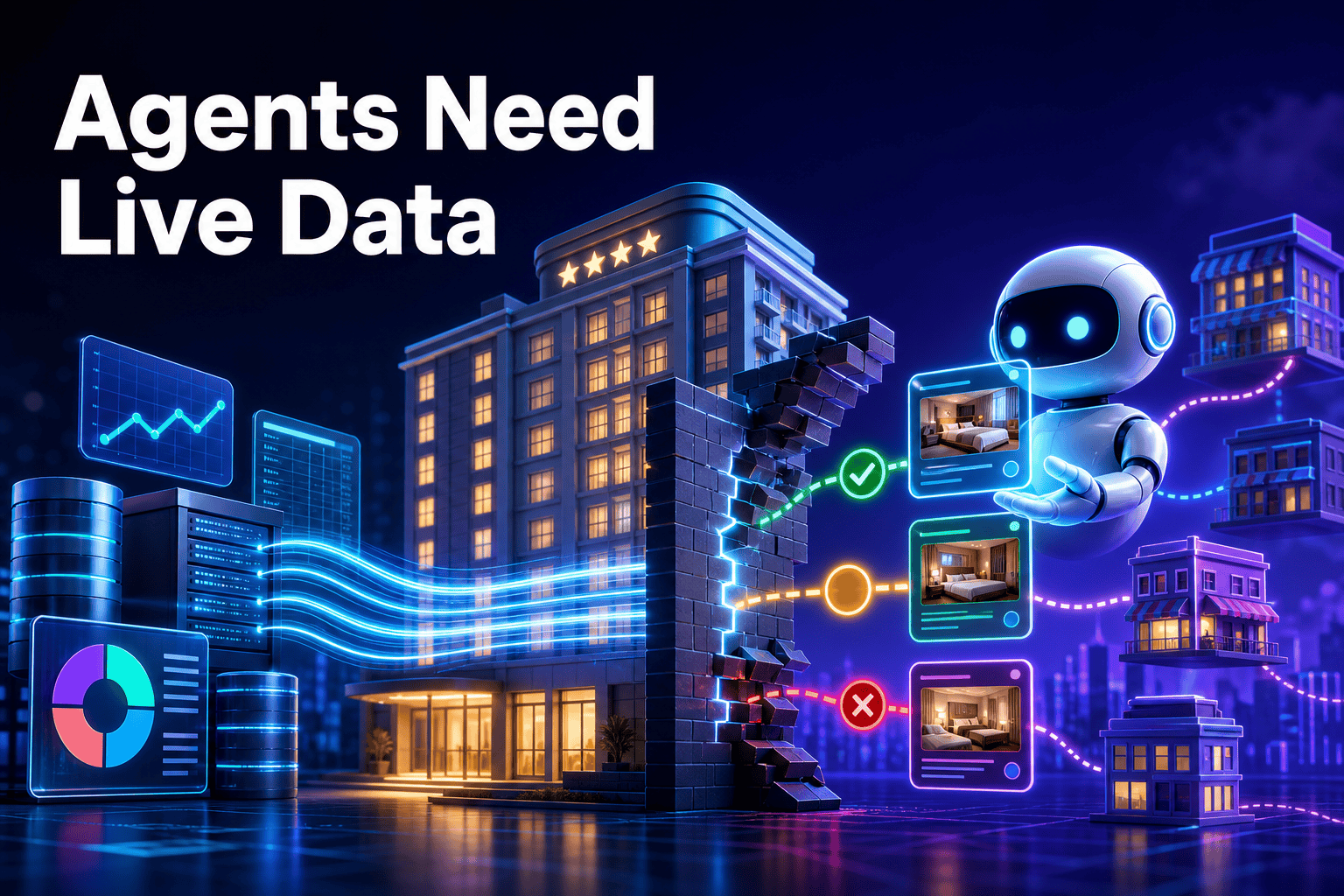
Hilton says it is not blocking AI shopping agents, but early tests reported by Skift and summarized by Renascence show that Meta’s Muse could not reliably pull live room rates from Hilton-branded sites. In practice, the agent often had to fall back to online travel agencies instead.
That may sound like a hospitality story, but it is really a warning for any company exploring ai agents for business. If your systems do not expose live data in a structured way, an agent can look smart in a demo and still fail at the moment that matters most: completing the task.
What happened at Hilton
The key point is simple. Hilton’s leadership says the company is not intentionally shutting AI agents out, but its booking stack was not built for autonomous software querying price and availability in real time.
That is a technical readiness gap, not a branding problem. An AI agent trying to shop or book needs dependable access to live room rates, inventory, and booking rules. If that access is inconsistent, the agent takes the easier route, and right now that often means an intermediary.
Why AI agents fail on live information
This is where many business owners get tripped up. The real difference in the ai agent vs chatbot discussion is that a chatbot can answer general questions, while an agent is expected to act inside real systems.
A human visitor can tolerate friction. They can click around, refresh a page, compare tabs, or infer missing details. An AI agent is faster, but also less forgiving. It works best when data is structured, current, and reachable through stable interfaces rather than hidden across pages, scripts, and disconnected tools.
| Task | Human visitor | AI agent | What happens if access is weak |
|---|---|---|---|
| Check current price | Browses pages and retries manually | Needs machine-readable live data | Agent may return no result or wrong route |
| Compare options | Reads text, images, and fine print | Needs structured fields and rules | Agent prefers simpler third-party sources |
| Complete a booking or purchase | Can work through confusing steps | Needs reliable transaction flow | Conversion shifts to an intermediary |
In agent-led commerce, being visible to humans is no longer enough. Your pricing, inventory, and policies also need to be visible to software.
That is why this Hilton case matters beyond travel. It shows that agent adoption is not only about better AI models. It is also about the underlying plumbing that lets those models get trusted, up-to-date information when a customer is ready to buy.
The same problem shows up in sales and support
Small and mid-sized businesses run into the same issue all the time. A company may have a polished website, an FAQ, and even ai customer support, but the important information still lives in spreadsheets, inboxes, PDFs, or a booking tool the AI cannot reach.
That is why many first deployments disappoint. Owners think they are buying automation, but they are really adding a new interface on top of disconnected systems. For first line support automation or sales automation to work well, the AI needs access to current stock, schedules, delivery terms, service availability, lead status, and internal rules.
- Prices change, but the website and the back office are out of sync.
- Availability exists in a booking or calendar tool, not in a usable data feed.
- Policies are buried in documents instead of a clean knowledge source.
- Customer and deal status live in a CRM, but the assistant cannot read or update them.
This is also why adding an ai chat widget for website is not the same as becoming agent-ready. A front-end chat experience is useful, but it does not solve the back-end access problem on its own.
How to make your business agent-ready without overbuilding
You do not need Hilton’s scale to learn from this. In fact, smaller teams can often move faster because they have fewer legacy systems to untangle.
- Start with one live workflow. Pick a task that matters commercially, such as checking appointment availability, confirming delivery windows, or qualifying inbound leads with current pricing.
- Map the data sources behind that workflow. List where the truth actually lives: CRM, booking tool, spreadsheet, help center, catalog, or order system.
- Create structured access before you add complexity. If the AI cannot reach the source reliably, the interface will not save you.
- Separate answer quality from action quality. Many assistants can answer nicely. Fewer can complete a transaction or update a business system accurately.
- Test with real tasks, not only demos. Ask the agent to do what customers actually ask for, especially when data changes during the day.
This is where mcp servers and the broader model context protocol become practical, not theoretical. They give businesses a cleaner way to connect assistants to the tools that hold live context, whether you want to connect ChatGPT to business tools or let Claude work with your CRM and internal systems.
For smaller teams that want to experiment without custom development, platforms such as botb2b.ai can help package the basics in one place: an AI front desk for your website chat widget and Telegram, a free CRM with task boards, a catalog of AI models, and MCP servers. That makes it easier to test ai agents without coding while keeping the focus on data access rather than on stitching tools together.
What this means for your business
The Hilton story is a good reality check. The next phase of AI adoption is not just about smarter models or prettier chat windows. It is about whether your business can expose the right live information at the exact moment an agent needs it.
For owners evaluating ai automation for small business, the lesson is straightforward: do not ask only, Can AI talk to customers? Ask, Can AI reach the systems that make an answer useful and an action possible? That is the difference between a nice demo and durable value.
- Treat live data access as revenue infrastructure. If pricing, stock, or availability changes often, agent access matters.
- Do not confuse FAQ automation with transaction readiness. Answering is easier than acting.
- Prioritize one journey end to end. A narrow workflow with real system access is better than a broad assistant with shallow knowledge.
- Choose flexible AI tools for SMB. The best setup is the one your team can maintain, test, and improve without heavy technical overhead.
In short, the brands that win with AI agents will not only have good customer-facing experiences. They will have business systems that are readable, connectable, and ready for software to use.