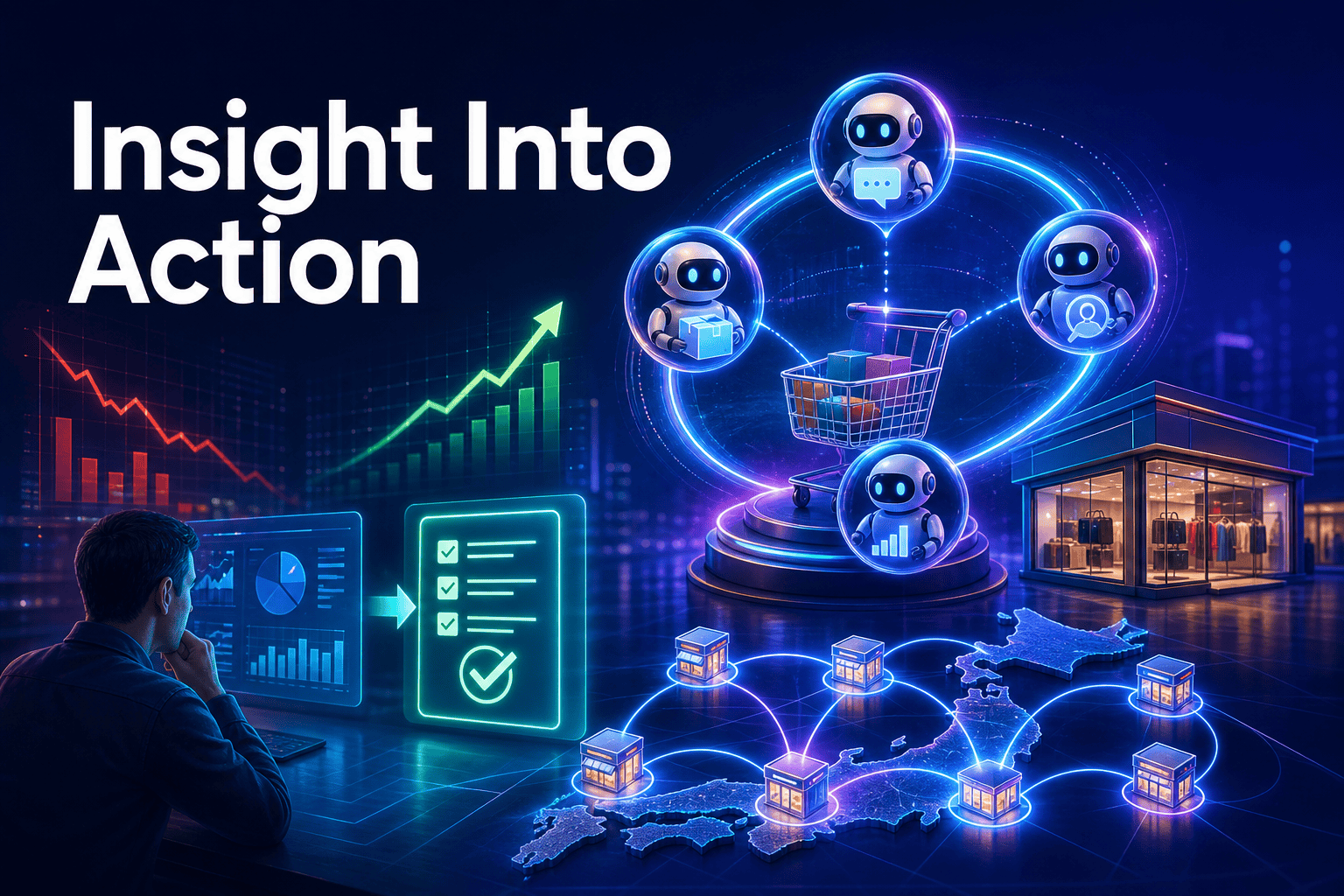
Fujitsu is testing what useful retail AI looks like
Fujitsu has launched a trial environment for four AI agents with seven retail companies in Japan. The agents cover sales structure analysis, customer loyalty analysis, merchandise planning, and support for store managers, including recommendations based on sales data plus outside signals such as weather, local market conditions, store characteristics, and social activity.
Why does this matter beyond big retail? Because it shows where ai agents for business are heading: not just telling teams what happened, but helping them decide what to do next. For owners and operators, that is one of the clearer ai trends for small business to watch right now.
What Fujitsu is actually trialing
This is not a single all-purpose bot. Fujitsu is testing four specialized agents on top of a shared execution layer for data storage, processing, and access control. In practical terms, that means each agent can work from the same business context instead of acting like a disconnected tool.
| Agent | Main job | What SMBs should notice |
|---|---|---|
| Sales structure analysis | Breaks down sales performance, finds imbalances, and suggests profit improvements | AI is being used to point out where action is needed, not only where numbers changed |
| Customer loyalty analysis | Looks for behavior patterns, motivations, and churn signals beyond basic metrics | Customer data can be turned into practical retention ideas, not just reports |
| Merchandise planning | Builds product and store-level plans and recommends inventory allocation | Planning can become faster when AI combines demand, competition, and stock context |
| Store manager support | Uses internal sales data plus market, weather, and social inputs to suggest assortment and shelf changes | The strongest use cases mix internal business data with external signals |
The important part is the move from analysis to recommendation. Fujitsu is pushing past dashboards toward an operational layer that gives staff next-step suggestions. That shared execution layer matters because AI becomes more useful when teams are working from the same information base rather than copying data between systems.
The big idea in the Fujitsu trial is simple: AI becomes valuable when it shortens the distance between insight and action.
Why this matters even if you are not a retailer
Most smaller businesses do not need four custom retail agents tomorrow. But many do face the same problem Fujitsu is addressing: data lives in too many places, reporting is slow, and by the time someone reacts, the opportunity has already moved.
That is why this story is really about ai automation for small business, not only retail. Whether you run an agency, a distributor, a service company, or an online store, the winning pattern is similar: gather context, detect a problem, recommend an action, and let a human make the final call.
- Sales: surface unusual drops, stalled deals, or product mix changes faster.
- Support: spot recurring complaints and route follow-up before they pile up.
- Operations: highlight stock issues, handoff delays, or missed tasks earlier.
- Management: give owners a clearer daily view of where attention is needed most.
The practical benefit is not replacing your team. It is giving people faster context so they spend less time hunting for information and more time making decisions. That is where business AI starts to feel real.
AI agent vs chatbot: why the distinction matters
Many business owners still hear AI and picture a website chat bubble. That can be useful, but the Fujitsu example is a better way to understand ai agent vs chatbot. A chatbot mainly answers questions, while an agent can combine data, follow a process, and suggest actions inside a workflow.
For example, a customer-facing bot may handle routine questions and basic lead capture. An agent goes further by noticing that certain requests keep appearing, summarizing the pattern, and pushing the issue into your internal workflow so someone can act on it. That is a much bigger step than simple FAQ automation.
This distinction matters because many SMBs should start with a small customer-facing layer and then connect it to internal work. In practice, that might mean a front desk in your website chat widget and Telegram for incoming questions, plus an internal assistant that turns those conversations into tasks, notes, and follow-up for the team.
How smaller companies can apply this without enterprise complexity
You do not need Fujitsu-scale infrastructure to use the same logic. What you do need is a narrow process, clean enough inputs, and a clear outcome the AI should support. That is why ai agents without coding are becoming more interesting for SMBs: they lower the cost of testing useful workflows.
One practical example is botb2b.ai, an international platform with ai employees. It includes an AI front desk for your website chat widget and Telegram, a free CRM with task boards, a catalog of AI models, and mcp servers that help you connect ChatGPT to business tools and give Claude access to the same business context, all without hiring a developer.
A simple rollout path
- Pick one process where delays hurt every week, such as new inquiries, support triage, or order follow-up.
- Decide what data the AI needs to see, such as documents, FAQs, CRM records, or inventory notes.
- Set a clear output, like a recommended next action, a summary, or a task for a human to review.
- Review the suggestions weekly and tighten the rules before expanding to another workflow.
The point is not to build a giant digital system on day one. It is to create a small, reliable workflow that saves attention and helps your team move faster with better context.
What this means for your business
Fujitsu's trial is a useful signal that AI projects are maturing. The conversation is shifting from generic AI hype to specific workflows, shared data, and recommendations people can actually use in daily operations.
For SMB owners, the takeaway is straightforward: start where decisions are slow and information is scattered. That may be support, lead intake, sales planning, or store-level operations. The companies that benefit first will be the ones that give AI a clear job, the right context, and human oversight.
You do not need to wait for a large enterprise rollout in your market to apply the lesson. If an AI system can help your team answer faster, prioritize better, and spot issues earlier, it is already worth testing on a small scale.