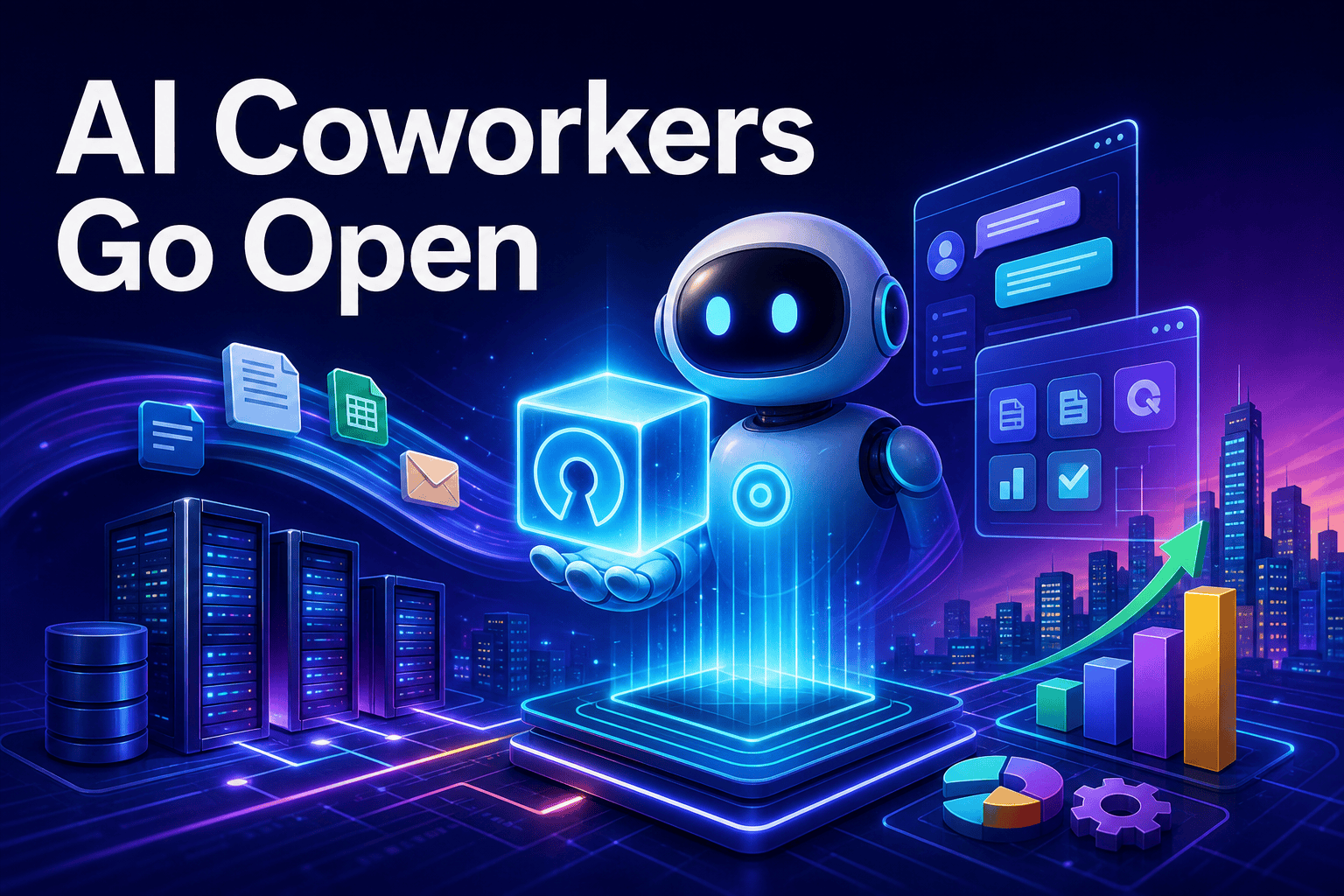
Tencent has quietly released Octop as open source, giving companies a new self-hosted option for agent-based work. On the surface, this looks like one more GitHub project. In practice, it looks much closer to Tencent exposing the building blocks behind a WorkBuddy-style product for internal workflows.
For owners evaluating ai agents for business, that is the real story. The market is moving past simple chat helpers and toward systems that can take a goal, use tools, access knowledge and complete pieces of work with less hand-holding.
What Tencent actually released
Tencent Cloud published Octop under its official GitHub organization as an open-source, self-hosted AI assistant released under the MIT License. According to the source, it supports multi-user and multi-agent scenarios, expert libraries, Skills, knowledge bases, long-term memory, OAuth, MCP and plugin extensions.
It also comes with tools that make it more than a demo: browser automation, Terminal, scheduled tasks and remote desktop. Octop can connect to workplace apps including Lark, DingTalk, QQ, WeCom and Discord, which means the agent can sit closer to real daily processes instead of staying trapped inside one browser tab.
The important part for a business reader is control over internal workflows. Self-hosted tools appeal to teams that want chat records, workspaces and credentials to stay on their own infrastructure while keeping freedom to choose models and extend the system over time.
AI agent vs chatbot: why this release feels different
A traditional chatbot usually waits for a question and returns an answer. An agent works from a goal: it can break the task into steps, look up context, call tools and deliver an outcome. That shift is at the center of the ai agent vs chatbot discussion.
The Tencent comparison matters because both WorkBuddy and Octop are built around role-based agents, sometimes described as ai employees. Instead of one general assistant doing everything poorly, you get separate experts for operations, coding, data or task coordination, each with its own workspace and permissions.
For a small or midsize company, that does not have to mean a giant transformation project. It can mean an operations assistant that prepares weekly updates, an internal support helper that answers from company documents, or a workflow assistant that follows up on tasks across your existing tools.
The big signal from Tencent is not just open source. It is that business software is being rebuilt around agents, tools, memory and system connections, not around a smarter chat box alone.
Open-source stack or ready-made AI agent platform?
Tencent seems to be supporting two paths at once. WorkBuddy is positioned as the easier productized workspace for ordinary users, while Octop is the more flexible toolkit for developers, small teams and enterprises that want to assemble and modify their own setup. In other words, the difference is not just features. It is who controls the complexity.
| Area | WorkBuddy approach | Octop approach | What it means for an SMB |
|---|---|---|---|
| Setup | More packaged and ready to use | Self-hosted and customizable | Choose between speed and flexibility |
| User focus | General business users | Developers, teams and enterprises | Your technical capacity matters |
| Model choice | Complexity is mostly hidden | Can connect to different providers | Useful if model freedom is important |
| Extensions | Product features and built-in flows | Plugins, MCP and custom changes | Better for bespoke workflows |
| Data control | Managed product experience | Local deployment options | Important when data location matters |
If you have technical resources, strict compliance needs or a strong reason to keep everything in-house, an open-source stack can make sense. But many companies do not need to start there. A practical ai agent platform is often the faster first step.
That is where an international platform like botb2b.ai can fit naturally. It gives businesses usable AI employees without a custom build: an AI front desk for your website chat widget and Telegram, a free CRM with task boards, a catalog of AI models, and MCP servers that connect assistants like Claude and ChatGPT to business tools without hiring a developer.
Why model context protocol matters for SMBs
One of the most useful details in this story is Tencent's emphasis on model context protocol and connectors. MCP is the plumbing that lets an assistant reach beyond chat, securely use tools and move information between systems.
That matters because the real business value rarely comes from the model alone. It comes from whether you can connect ChatGPT to business tools, give Claude access to approved actions, or let an agent pull the right files, update a task board and write back useful context for the next step.
Without that connection layer, many agents stay at demo level. With it, they start to support real processes. This is especially relevant for mcp servers and ai automation for small business, where the winning setup is usually not the most advanced model but the one that fits cleanly into the tools your team already uses.
What this means for your business
If you run a small or midsize company, this release is a useful signal. The next wave of business AI will not just answer questions. It will combine roles, knowledge, tools and permissions into a lightweight workflow layer that can take repetitive work off your team's plate.
- Start with one workflow such as internal knowledge lookup, task follow-up or document-based support before thinking about a full multi-agent system.
- Choose the right level of control. If local deployment and deep customization matter, projects like Octop are worth watching. If speed and simplicity matter more, start with a managed tool.
- Plan around connections, not just model quality. The best assistant is usually the one that can access the right documents and systems safely.
- Think in roles. One focused agent for one business process is easier to manage than a single assistant expected to do everything.
Tencent's move shows how quickly the category is maturing. Even if you never deploy Octop, the direction is clear: AI at work is becoming more modular, more connected and more useful when it is tied to real business processes.