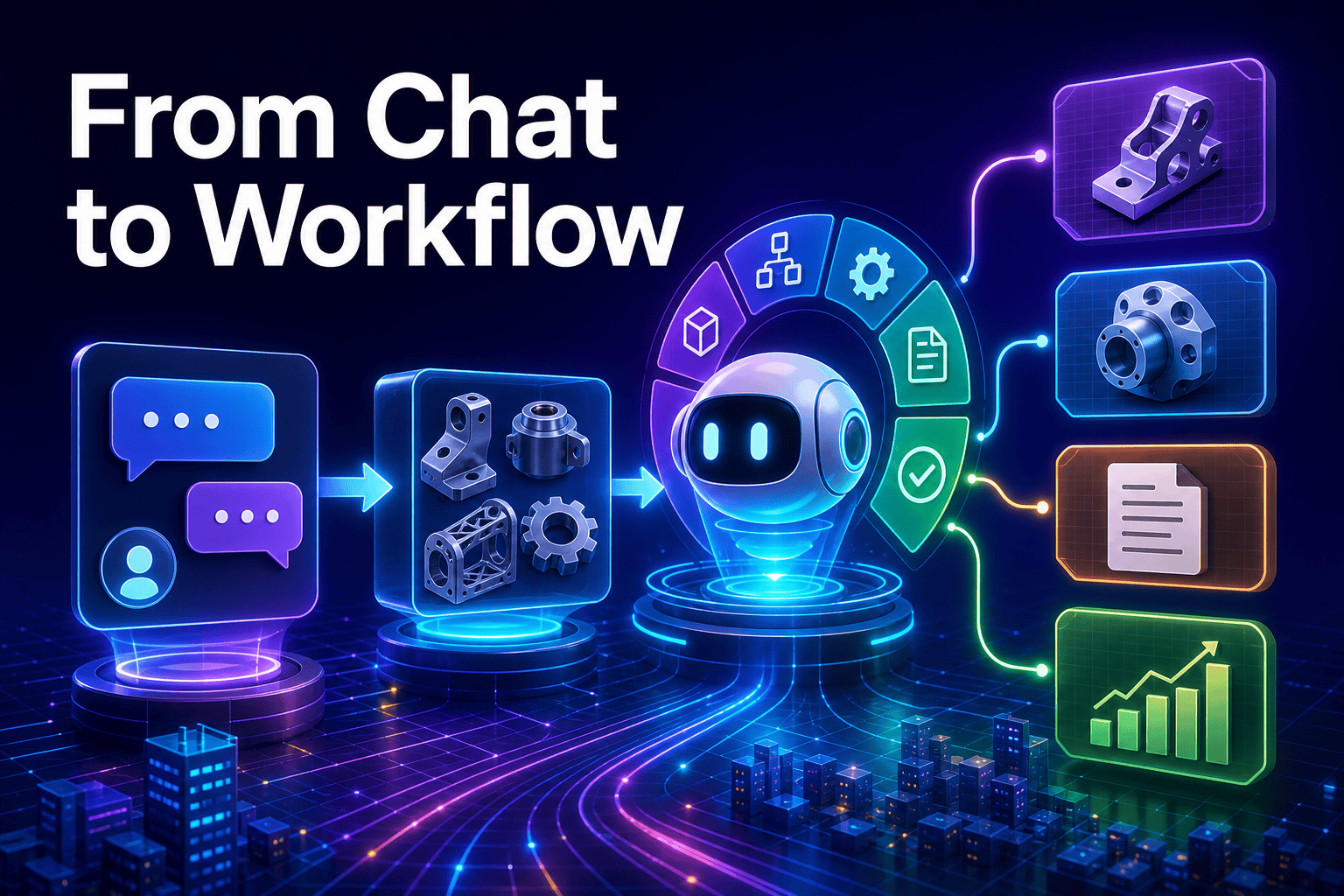
UnionTech says it has launched Quick AI, a process agent platform built for 3D workflows. The announcement highlights two very practical jobs: reusing 3D assets and automating tasks such as quoting. That may sound niche, but it points to a bigger shift in ai agents for business: AI is moving from answering questions to helping complete repeatable work.
For small and midsize companies, that matters because quoting, file reuse, handoffs, and admin steps are where time disappears. This is why the story belongs in ai news for business, not only in manufacturing news.
What UnionTech actually launched
Based on the announcement, Quick AI is meant to give business users more automation inside 3D-related work. The emphasis is not on a general chat assistant; it is on a system that can work with existing 3D assets and help with tasks like quoting.
That distinction matters. A simple assistant can answer questions, but an ai agent platform is more useful when it supports a workflow with inputs, rules, and outputs your team already uses. In this case, the news points to a workflow where prior assets are reused instead of rebuilt from scratch.
In plain language, UnionTech is highlighting a familiar business goal: stop recreating information, stop copying details between systems, and make recurring process steps easier for non-technical staff.
Why this matters beyond 3D printing
The important lesson is broader than 3D. Any company that works with repeat files, repeat estimates, or custom requests has a similar pattern. If the same information gets touched again and again, there is often room for ai automation for small business.
Think about how many teams still handle quotes, versions, and approvals through email, spreadsheets, and memory. When software can reuse prior assets or structured data, it helps automate routine tasks with ai instead of forcing people to restart from zero every time.
| Workflow area | Mostly manual approach | Process agent approach |
|---|---|---|
| Reusing past work | Staff search folders and old jobs by hand | Relevant assets can be surfaced and reused inside the workflow |
| Quoting | Details are re-entered and checked across multiple steps | Common inputs can be organized into a more consistent estimate flow |
| Handoffs | Teams depend on email threads and individual memory | Key context stays closer to the task as it moves forward |
| Business user access | Automation often waits for technical help | Process tools are aimed more directly at business users |
The big shift is simple: AI is becoming part of the process itself, not just a tool people ask for help.
Where small and midsize businesses can use the same idea
You do not need a 3D workflow to learn from this launch. The same logic works anywhere your team repeats a sequence: collect inputs, match them to existing materials, prepare an estimate, and move the job forward. That is where practical AI starts feeling less experimental and more operational.
Examples include:
- Custom manufacturers that reuse specs, drawings, or previous jobs when preparing estimates.
- Print shops, sign businesses, and fabricators that quote similar orders again and again.
- Agencies and B2B service firms that build proposals from past templates, pricing rules, and client documents.
- Operations teams that route incoming requests, create follow-up tasks, and keep context attached to the work.
In each case, the benefit is not magic. It is better consistency, less manual re-entry, and fewer small delays that pile up across the week. For owners, that usually means freeing up attention for sales, delivery, and decision-making.
Why connectivity matters as much as intelligence
A useful agent does not live in isolation. To do real work, it needs access to documents, CRM data, task boards, catalogs, or internal procedures. That is why mcp servers are getting more attention: businesses want AI that can work with their actual tools, not just chat in a separate window.
In practical terms, the next step after a smart model is a reliable way to connect it to business context. That is how AI becomes usable for quoting, internal routing, status updates, and process support rather than staying stuck as a demo.
This is also why platforms that package setup for business users are gaining traction. For example, botb2b.ai is an international platform with AI employees: an AI front desk for your website chat widget and Telegram, a free CRM with task boards, a catalog of AI models, and MCP servers that connect AI assistants to business tools without hiring a developer. The broader lesson from the UnionTech launch is that value often comes from the workflow layer, not from the model alone.
What this means for your business
If you run an SMB, the practical question is not whether you need a 3D platform. It is whether parts of your business follow the same pattern: repeated inputs, repeated files, repeated quotes, and repeated handoffs. If yes, an ai agent for small business may be most useful in operations, not only in marketing.
A good starting point is to review one workflow that people complain about but still repeat every day. Map the inputs, the systems involved, the output, and the approval step. Then ask whether an AI team member could help collect data, prepare a first draft, route the task, or pull from past materials for human review.
- Pick one narrow process with clear steps.
- Gather the files, rules, and examples it depends on most.
- Choose a tool that business users can manage without a custom build.
You do not need to automate everything at once. Start small, keep a human check where it matters, and look for software that fits the way your business already works. That is the clearest takeaway from this news: the next wave of adoption will come from process agents that save attention, not from flashy demos alone.