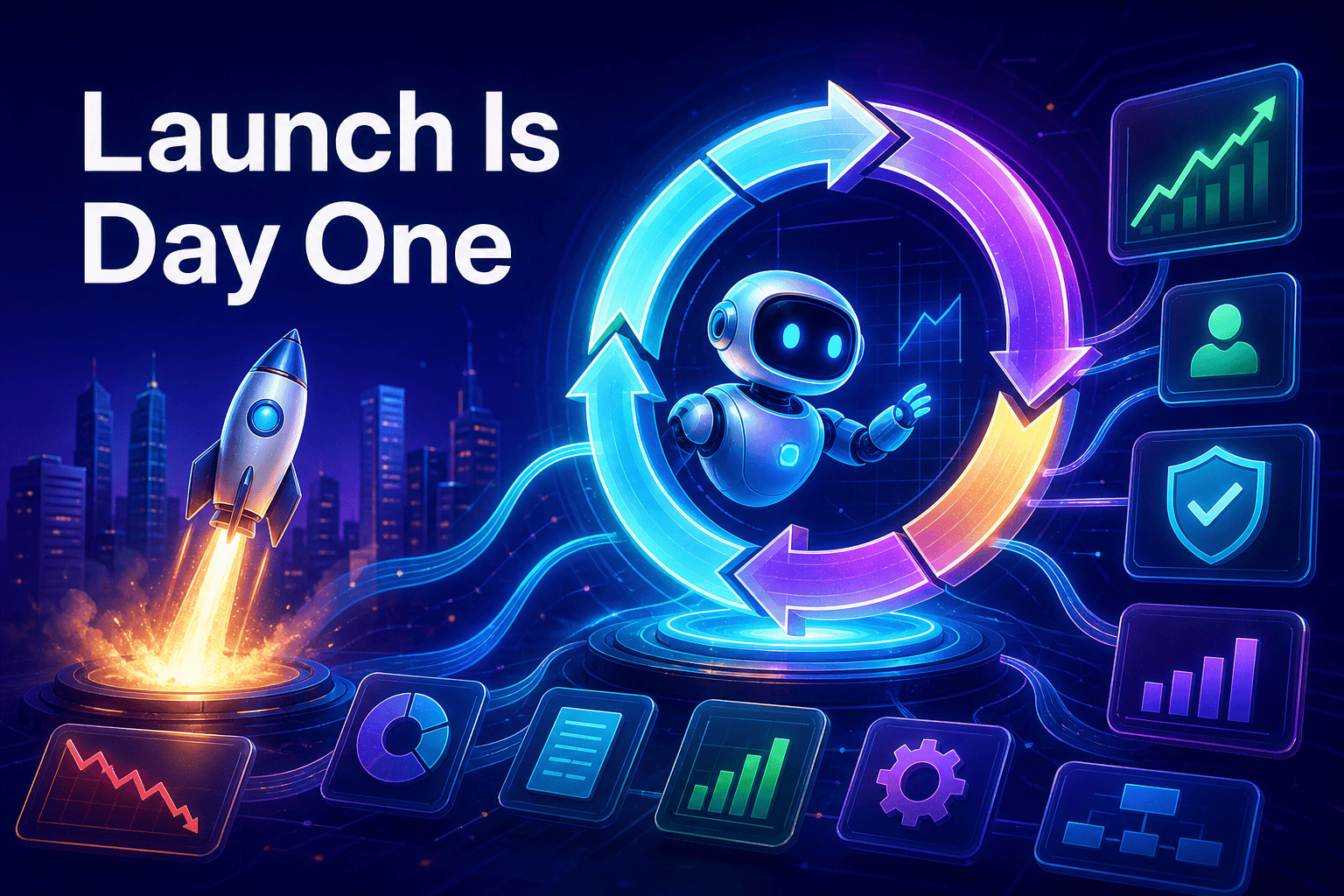
Kore.ai has launched Autoloop, an always-on optimization engine for enterprise AI agents. In simple terms, it is meant to keep an agent aligned with business goals after it goes live, instead of leaving teams to patch problems by hand every time something breaks.
That matters far beyond large enterprises. One of the biggest ai trends for small business is that companies are no longer asking only how to launch a tool, but how to manage it once it becomes part of daily sales, support, and operations.
What Kore.ai actually launched
According to the announcement covered by Relve, Autoloop is a post-deployment optimization layer for enterprise agents. Kore.ai says customers can set multiple goals at once, including task completion, rule adherence, accuracy, and cost, and the system will tune the agent across those objectives instead of optimizing just one metric.
The company is aiming at a real pain point. In Kore.ai’s 2026 index, 79% of enterprises said they had reversed an AI agent action, and 70% said they had run into failures their teams could not trace. That is a strong signal that the hard part of ai agents for business is often not the launch, but what happens after launch.
Two technical pieces stand out in the news. Kore.ai says StateTrace evaluates full runs by tracking handoffs, tool calls, and state changes, while its Agent Blueprint Language compiles routing, rules, and guardrails into a state machine so Autoloop can rewrite only the part that missed. The feature is available now in the Artemis edition, and Kore.ai says its platform serves more than 500 Global 2000 clients.
Why this matters beyond the enterprise
Even if you are not buying a large enterprise stack, the message is important: AI agents are not set-and-forget software. Once an agent starts answering customers, qualifying leads, updating records, or using business tools, small errors can turn into repeated operational problems.
This is also where the old ai agent vs chatbot discussion becomes practical. A basic chatbot can give a weak answer and the damage may be limited. An agent that can follow workflows, call tools, and make decisions creates more value, but it also needs better monitoring, clearer rules, and a cleaner way to improve specific steps without changing the whole system.
For smaller companies using AI for support or lead handling, the lesson is straightforward. If you want to automate customer support with ai, you need more than a good prompt. You need to know what success looks like, where the agent gets stuck, when a human should step in, and how changes will affect quality and cost at the same time.
The real shift is this: businesses are moving from launching AI agents to operating them, and operations require visibility, control, and safe iteration.
What to ask any AI agent platform before you buy
Kore.ai’s launch highlights a useful buyer framework for any ai agent platform, whether it is built for large enterprises or smaller teams. You do not need the exact same architecture, but you do need answers to a few operational questions.
| Signal from the news | What Kore.ai says | Why SMBs should care |
|---|---|---|
| Reversed actions | 79% of enterprises reported reversing an agent action | If an agent can do real work, you need approval rules, fallback paths, and a clear way to undo mistakes |
| Untraceable failures | 70% encountered failures they could not trace | If you cannot see why an answer or action failed, improvement becomes guesswork |
| Multi-objective tuning | Autoloop optimizes completion, rules, accuracy, and cost together | Lower cost is not useful if service quality or policy compliance drops |
| Targeted fixes | StateTrace and ABL aim to rewrite only the failing component | Smaller, more precise changes usually mean less risk than editing everything at once |
When you review an ai customer support setup or a website agent, ask questions like these:
- Can I define success using more than one metric?
- Can I see the full path the agent took before it gave an answer or took an action?
- Can I fix one part of the workflow without rebuilding the entire agent?
- Can I tell when lower spend is coming from real efficiency versus retries, guardrails, or extra human review?
Why no-code teams should care now
For many smaller businesses, the appeal of ai agents without coding is obvious. They lower the barrier to entry, make testing faster, and let teams launch useful workflows without waiting on a full development cycle.
But easier setup does not remove the need for control. In fact, once AI becomes part of front-desk conversations, support triage, or internal task routing, operational clarity becomes more important, not less. That is especially true when you start connecting assistants to other tools through mcp servers or the broader Model Context Protocol.
This is where a simpler stack can still benefit from the same mindset. For example, some teams start with botb2b.ai as an international platform with AI employees: an AI front desk for a website chat widget and Telegram, a free CRM with task boards, a catalog of AI models, and MCP servers that connect AI assistants like Claude and ChatGPT to business tools, all without hiring a developer. The point is not to copy an enterprise setup feature by feature, but to remember that launch day is only the beginning.
That same principle applies whether you are testing a support agent, a sales workflow, or broader ai automation for small business. The more useful the agent becomes, the more you need a way to review, tune, and govern it over time.
What this means for your business
Kore.ai’s Autoloop launch is a news story about enterprise software, but the takeaway is universal. Start simple, then manage actively. Do not judge an AI system only by how fast you can launch it; judge it by how clearly you can improve it a month later.
If you are evaluating AI for support, sales, or operations, keep your first rollout focused:
- Choose one workflow with a clear owner.
- Set 3 or 4 success criteria before launch, such as completion quality, policy adherence, speed, and cost awareness.
- Review failures regularly and look for patterns, not one-off mistakes.
- Make sure there is an easy human fallback for edge cases.
The biggest practical insight from this launch is not that every SMB now needs an enterprise optimization engine. It is that good AI operations matter as much as good AI outputs. If your agent helps customers, captures leads, or updates business systems, the winners will be the companies that can see what happened, fix the right step, and keep improving without chaos.