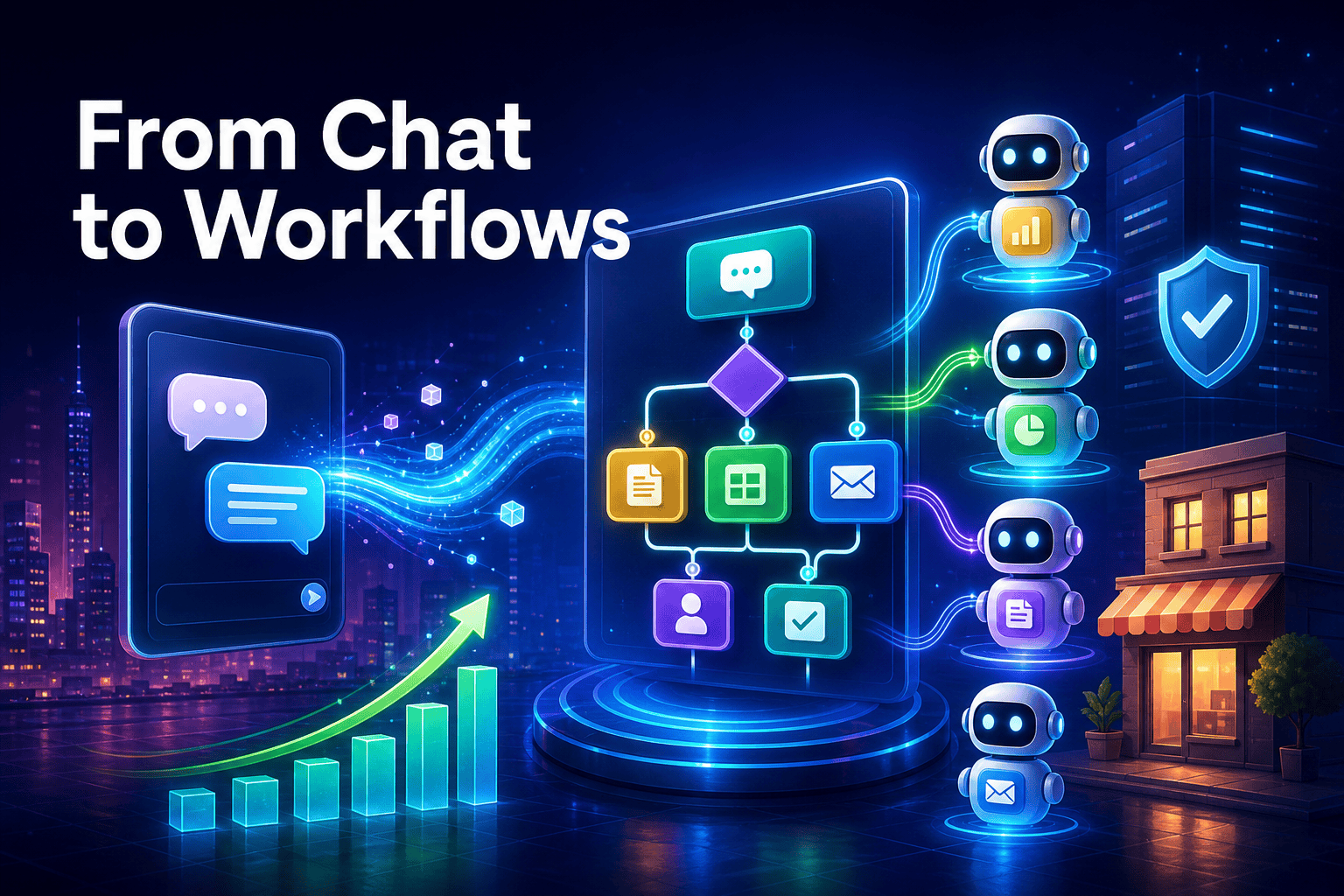
AWS rolled out a major Quick update on November 20, adding chat-built workflows, multi-agent orchestration, new connectors, and stronger admin controls. For business owners, this matters because the market is moving beyond simple chatbots: ai agents for business are becoming repeatable systems for sales, support, reporting, and internal operations.
The important part is not just that Quick can answer a question. It can now help teams describe a process in plain language, turn it into a reusable flow, and run it again with human review and permissions in place. That is a meaningful step for ai automation for small business, especially for companies that want more output without adding more tool complexity.
What AWS actually launched
The headline feature is simple: a user can describe a business process in chat, and Quick builds a flow around it. That flow can include agents, tools, structured data, knowledge, apps, and fixed steps for calculations or checks, with a visual diagram beside the chat for review.
AWS also added multi-agent orchestration, which lets one agent call several specialized agents at the same time and combine their outputs. Quick's updated web app, reusable skills, and support for longer-running tasks across web, desktop, and mobile make the feature set feel more like a work system than a one-off assistant.
| Update | What changed | Why it matters |
|---|---|---|
| Chat-built flows | Describe a process in chat, then run and refine it. | Makes recurring work easier to standardize. |
| Deterministic steps | Fixed formulas, checks, and rules sit beside agent reasoning. | Better consistency for reporting and operations. |
| Multi-agent orchestration | Several specialist agents can work in parallel. | Useful for cross-functional tasks. |
| MCP connectors | Meta ads and Amplitude connect through MCP. | AI can work across business tools under permissions. |
| Pomelo example | Nearly 4x more people worked with data monthly, and one use case saves 80 hours a month. | Shows the direction of broader access, not a guaranteed outcome. |
Why chat-built workflows matter more than a better chatbot
Many companies already use AI for one-off prompts. The harder part is turning recurring work into something the whole team can run without depending on the one person who originally figured it out. That is why ai agents without coding are such a big theme right now.
With Quick, the user can build, test, and refine a flow inside the same conversation. The business value comes from repeatable workflows: steps happen in the right order, checks stay consistent, and a person can still review the result before it goes out.
Workflows vs chatbots: the practical difference
A basic chatbot answers questions. A workflow-based agent can take a request, pull the right context, run fixed checks, draft output, wait for approval, and stay available for the next person. For owners and team leads, that is the difference between a clever demo and something you can actually use every week.
The real shift is from AI as a one-off helper to AI as a reusable process your team can run again and again.
Multi-agent orchestration is the bigger story
Quick's other important change is that one agent can coordinate several specialist agents instead of pretending to know everything itself. Each agent keeps its own instructions, knowledge, and context, so finance, operations, and procurement can all maintain their own expertise while the user sees one combined response.
Separated expertise matters because most real business questions cross departments. AWS used examples like shipping-cost analysis and monthly reporting, but the same pattern fits quoting, stock checks, onboarding, compliance reviews, or internal support in smaller firms.
For SMBs, this does not mean replacing your team. It means freeing up time by routing the first pass of work to the right AI components and keeping the human decision where it matters.
Connectors, Model Context Protocol, and governance matter just as much
Automation only becomes useful when AI can work with the systems your team already uses. In this update, AWS highlighted connectors including Meta ads and Amplitude, both tied to Model Context Protocol through MCP servers. In plain language, that means AI is not limited to chat - it can work across tools in a more structured way.
The other half of the story is control. Administrators can decide which integrations teams may add, require permission for write actions, apply group-based limits, and test guardrails before enforcing them. AWS also says customer data stays in the customer environment and is not used to train other models.
For smaller companies evaluating mcp servers, this is the practical lesson: connectivity is only valuable when it comes with boundaries. That is also why some SMBs look at botb2b.ai, an international platform with ai employees, an AI front desk for a website chat widget and Telegram, a free CRM with task boards, and MCP servers that connect ChatGPT to business tools without hiring a developer.
What this means for your business
AWS Quick is another sign that the next phase of business AI is not just about answering prompts. It is about packaging repeatable work so more people can use it safely, with clear approvals, connectors, and ownership. That is especially relevant if your company wants to automate routine work with AI without turning daily operations into an experiment.
A good starting point is to choose one process that already happens every week. Think lead qualification, recurring support triage, weekly reporting, proposal prep, or internal request handling. If you can describe the steps clearly, you probably have a strong candidate for your first business AI workflow.
- Pick a workflow with repeatable steps and visible business value.
- Keep human approval where money, compliance, or customer promises are involved.
- Separate knowledge by function instead of forcing one giant agent to do everything.
- Prioritize tools that support permissions, connectors, and reusable flows, not just chat.
If you want to start small, begin where conversations and tasks already exist. That could mean an AI front desk through an ai chat widget for website, a Telegram entry point, or a connected internal workflow. The broader lesson from AWS is clear: the companies that benefit most will be the ones that turn everyday work into reliable systems their team can actually run.