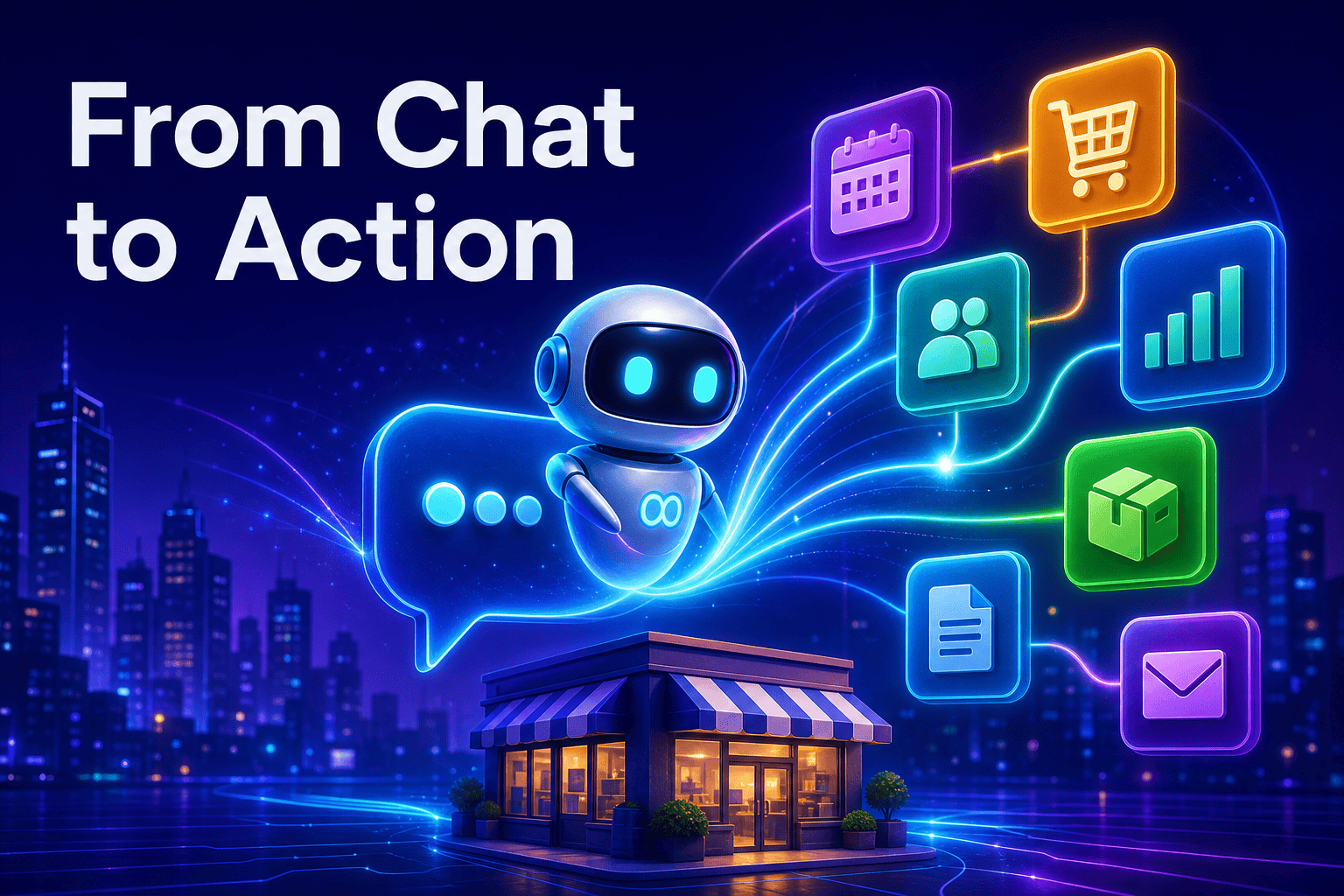
Meta is bringing AI agents to small businesses by connecting them to common business tools. That may sound like another product update, but it points to a bigger shift from chat assistance toward operational automation.
For owners and managers, that matters because the conversation is changing. The question is no longer only whether AI can answer customers. It is whether AI can help move work forward without making your setup harder to manage.
From assistant to operator
For the past few years, many smaller companies have used AI mainly as a chat layer. It could answer basic questions, summarize information, and hand off to a human when things got more complex. Useful, yes, but still limited.
Meta’s move points toward AI agents for business that are connected to the systems a company already uses. Once an agent can understand the right context and support the next step in a workflow, it stops being just a talking interface and starts becoming part of the operation.
That is why AI agent vs chatbot is no longer just a technical distinction. A chatbot mostly responds. An agent responds and helps move the process forward.
| Approach | Main role | Business value |
|---|---|---|
| Basic chatbot | Answer common questions | Useful for simple requests and FAQ-style support |
| Connected AI agent | Answer and support workflow steps | Helps turn a conversation into a practical next action |
Why this matters for support and sales
For most small businesses, the first clear use case is AI customer support. Instead of only sending generic replies, an agent can work from approved information, keep responses more consistent, and help your team avoid repeating the same explanation all day.
The second big area is early-stage sales. A practical AI sales agent can handle first contact, ask useful questions, and make sure a person joins the conversation with better context instead of starting from scratch.
The real shift is not that AI can answer more questions. It is that connected agents can help turn conversations into next actions inside an actual business process.
This matters even more for lean teams. When the owner, sales lead, and support contact are sometimes the same person, anything that reduces friction in the first step of a customer interaction can free up time without changing how your business works at its core.
Where small businesses should start
If you are exploring AI automation for small business, begin with repeatable tasks. The best starting points have clear rules, common questions, and a simple handoff when AI reaches its limit.
- Website support intake: let AI answer common questions, collect relevant details, and pass tougher cases to a person.
- Lead capture: use AI to ask a few smart questions before your team joins the conversation.
- Knowledge-based replies: give the system access to your service information, policies, or product documents so answers stay closer to how your business actually works.
The main mistake is trying to make one AI tool do everything at once. Smaller, narrower workflows are easier to review, easier to improve, and much easier for your team to trust.
How to do this without a custom stack
One reason this market is moving faster now is that AI agents without coding are becoming more realistic for smaller companies. You do not need a custom build just to test whether an agent can help with your website conversations, support flow, or internal follow-up steps.
This is also where MCP servers matter. In simple terms, the model context protocol helps AI assistants connect to business tools and use the right context more effectively, so the assistant can do more than generate text on its own.
If you are comparing platforms, look for practical pieces rather than flashy demos: a website chat widget, a simple CRM or task view, a clean knowledge setup, and a straightforward way to connect assistants to the tools your team already relies on.
That is one reason platforms like botb2b.ai are relevant in this conversation. It offers an AI front desk for your website chat widget and Telegram, a free CRM with task boards, a catalog of AI models, and MCP servers that connect assistants like Claude and ChatGPT to business tools without hiring a developer. The brand is less important than the direction: easier setup, clearer workflows, and less dependency on custom development.
What this means for your business
Meta’s latest move is a signal that the AI agent for small business is becoming practical infrastructure, not just a novelty feature. Small companies can start thinking beyond a smarter FAQ box and toward AI that supports support, sales intake, and day-to-day coordination.
A smart next step is simple:
- Pick one workflow with repeated questions or repeated handoffs.
- List the information an agent would need to handle that workflow well.
- Test a small deployment, review the conversations, and refine before expanding.
You do not need a fully automated operation on day one. But you do need a clearer standard for useful AI: less generic chatting, more meaningful help inside real business processes. That is why this news matters now, and why smaller businesses should pay attention.