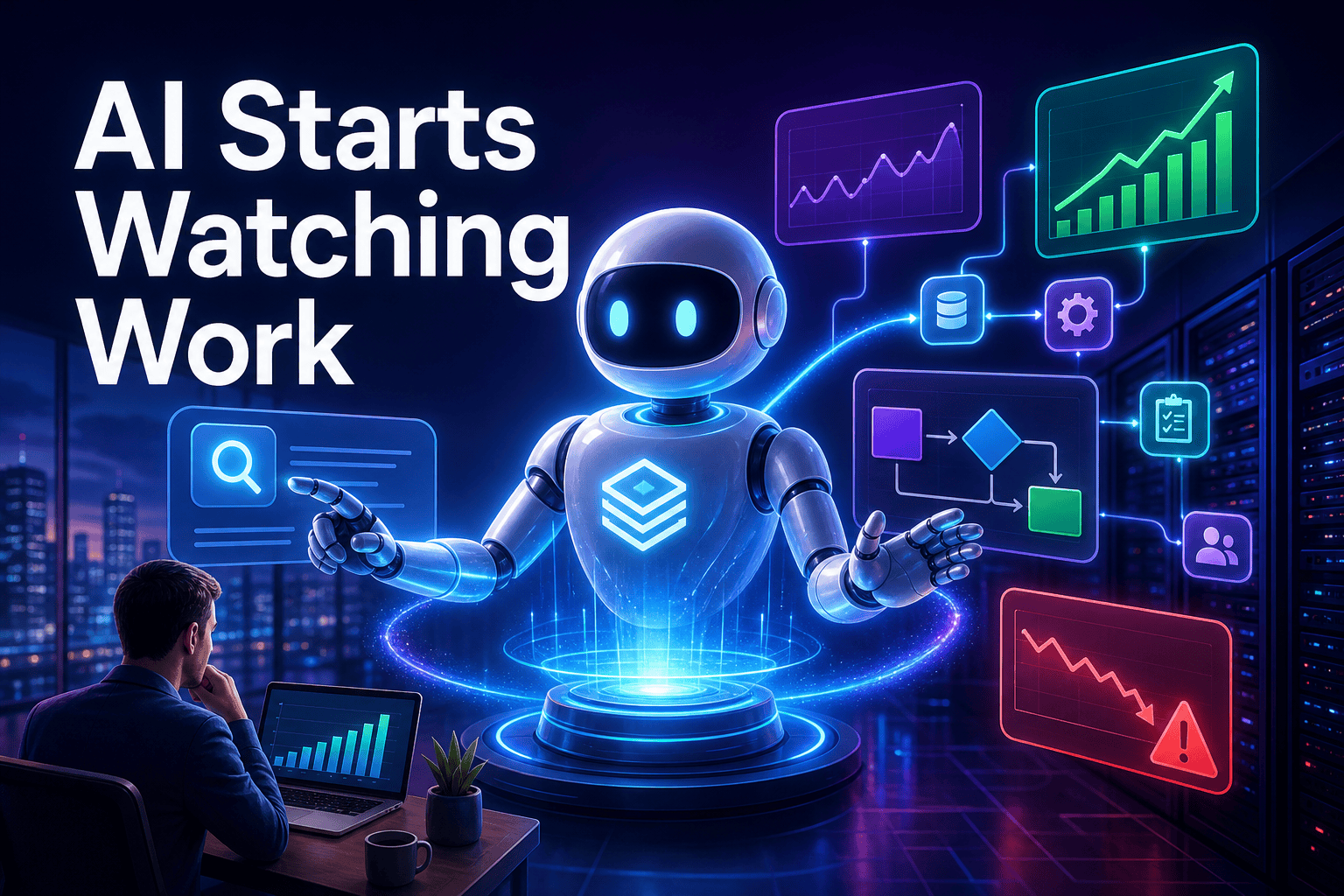
Databricks has upgraded Genie into an always-on AI agent that can analyze business data, handle multistep workflows, and flag operational issues. That sounds like enterprise software news, but the bigger signal is much broader. For owners looking at ai agents for business, this is the moment to pay attention to how AI is moving from answers to action.
From assistant to always-on operator
Many business AI tools started as chat interfaces layered on top of reports, documents, or a knowledge base. You ask a question, the system replies, and the interaction ends there. With Genie, Databricks is pushing toward something more active: an always-on agent that stays close to business data, can follow multistep workflows, and can spot issues before someone remembers to check a dashboard.
That matters because it points to the next stage of ai employees. The real shift is not the chat box itself. It is the combination of context, persistence, and workflow handling that makes AI useful between requests, not only during them.
Why this matters beyond enterprise IT
Small and medium businesses often treat these announcements as something for giant companies with data teams and complex systems. In reality, enterprise launches often show where the rest of the market is heading. What starts as a high-end product today often becomes tomorrow's ai automation for small business tool.
For an owner, the practical takeaway is simple: look for AI that can watch, organize, and escalate, not just answer. Most teams do not need more dashboards or more scattered notifications. They need fewer manual check-ins and clearer next steps when something changes.
| Approach | What it does | Works well for | Main limit |
|---|---|---|---|
| Dashboard | Shows data when a person checks it | Reporting and trend review | Someone still has to remember to look |
| Chatbot | Answers a question when prompted | FAQs and one-off lookups | Usually stops at the answer |
| Always-on AI agent | Monitors data, handles steps, and flags issues | Operational workflows and exceptions | Needs clear access to tools and rules |
The big takeaway from the Genie update is simple: the most useful business AI will not just talk about your company. It will stay close to your data and help move work forward.
AI agent vs chatbot: the practical difference
This news is a clear example of the real ai agent vs chatbot distinction. A chatbot is helpful when a customer or employee asks something specific. An agent becomes more valuable when it can connect information across steps, notice a mismatch, and keep a process moving.
Think about a delayed order, a drop in conversion, or a support backlog. A chatbot may explain the situation if you ask. An ai employee for business is closer to something that notices the issue, surfaces it quickly, and supports the next action inside the workflow.
This is why data access matters so much. If the AI cannot reach the systems where work happens, it remains smart but isolated. If it can securely use the right context and tools, it becomes much more useful in everyday operations.
What to look for in an AI agent platform
If this trend interests you, do not start by asking which model sounds most impressive in a demo. Start by asking whether the system can connect to your real process, whether it can pass work cleanly from one step to the next, and whether your team can maintain it without a long technical project. For many owners, the best ai agent platform is the one that fits existing work with the least friction.
This is also where mcp servers become practical, not abstract. They help connect assistants like Claude and ChatGPT to business tools so the AI can work with real context instead of generic text alone.
- Start with one narrow workflow such as lead intake, support triage, reporting follow-ups, or task routing.
- Check tool access early so the AI can read the right information and update the right system.
- Keep humans in the loop while you define rules, review edge cases, and improve handoffs.
- Prefer no-code setup where possible so the system is easier to maintain and easier for the team to adopt.
A good example of this lower-friction approach is botb2b.ai, an international platform with AI employees, an AI front desk for your website chat widget and Telegram, a free CRM with task boards, a catalog of AI models, and MCP servers that connect AI assistants to business tools without hiring a developer. For smaller teams, that makes connected AI much more realistic than a custom build.
What this means for your business
The Genie announcement is not important because every small business needs Databricks. It matters because it confirms where the market is going: from simple chat interfaces toward systems that combine data awareness, workflow handling, and issue detection.
For most owners, the smart next move is not a big AI overhaul. It is to map repetitive decisions and find one process where AI can monitor, route, or flag work more reliably. That could be lead handling, internal reporting, task follow-up, or first-line support.
- Choose one business role for AI instead of trying to automate everything at once.
- Prioritize systems that can connect ChatGPT to business tools or link other assistants to the places where your team already works.
- Measure usefulness by time saved, clearer handoffs, and fewer missed issues rather than by novelty.
The companies that benefit most from this shift will usually be the ones that start small, stay practical, and build around connected workflows. That is where AI stops being interesting software and starts becoming dependable operational support.