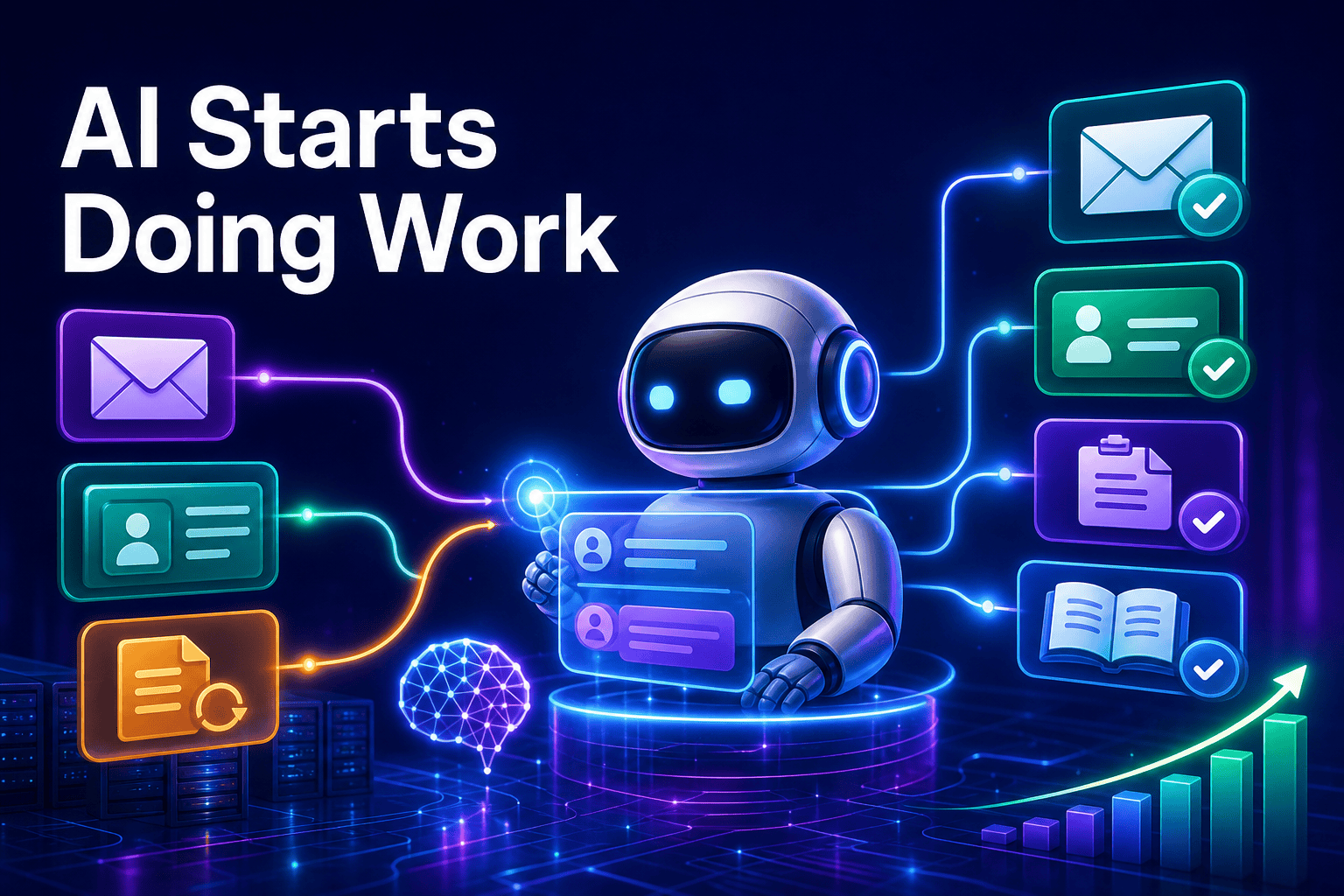
Air India has expanded its use of Agentforce from a single refund use case into a broader set of customer service workflows. That matters because it shows how ai customer support is moving beyond pilots and FAQ bots into systems that can actually complete work.
The airline now uses AI for automated email resolution, name change automation and a knowledge assistant for service teams. For owners and operators, this is a useful example of how ai agents for business become valuable when they are tied to real processes, real data and clear rules.
What changed at Air India
Air India's first Agentforce deployment focused on refunds, which already involved multiple validations, policy checks, backend-system interactions and cross-team dependencies. By orchestrating that process end to end, the airline said it reduced refund turnaround time from around 14 days to about four hours.
Now the company is widening the scope. The new rollout covers automated email resolution, name change automation and a real-time knowledge agent for service teams, showing a clear move toward end-to-end workflow automation rather than isolated chat interactions.
| Workflow | What the AI handles | Reported outcome |
|---|---|---|
| Refund processing | Validations, policy checks, backend interactions and cross-team orchestration | From about 14 days to about 4 hours |
| Automated email resolution | Finds multiple intents in one email, routes work, validates data and drafts one response | Used for eligible cases above a 95% confidence threshold |
| Name change automation | Eligibility checks, workflow callouts, ticket reissuance and updated ticket delivery | From about 3 days to about 30 minutes |
| Knowledge agent | Provides policies, procedures, fare rules and operational guidance to service teams | Faster information retrieval and more consistent responses |
The company also said the system uses ambient learning capabilities to improve prompts, workflows and model performance over time. That is a useful reminder that production AI is usually a process of steady refinement, not a one-time launch.
AI agent vs chatbot: why this story matters
Many businesses still hear 'AI support' and think about a simple bot that answers one question at a time. This case is a better example of ai agent vs chatbot: the system identifies multiple intents in a single email, invokes specialised sub-agents, gathers and validates information across systems, executes required actions, and then consolidates the result into one Air India-approved reply.
Just as important, the airline is not letting the system reply blindly. For eligible cases, responses are generated only when confidence is above 95%, with human oversight where needed. That is the practical pattern if you want to automate customer support with ai without creating extra risk.
The big shift is simple: businesses are moving from AI that talks to AI that completes work inside clear rules.
The knowledge agent matters for the same reason. A lot of customer service time is not spent typing; it is spent searching for the right policy, procedure or fare rule. When an assistant can surface that guidance in real time, teams can respond faster, stay more consistent and onboard new staff more smoothly.
The real lesson is integration and guardrails
Air India says it has a cloud-first digital ecosystem spanning more than 140 enterprise systems and more than 30 agentic AI initiatives. Most smaller companies do not need anything close to that scale, but the logic is the same: good AI support depends on integration and guardrails, not just on a smart model.
The airline evaluates its AI work across four pillars: increasing revenue, reducing cost, enhancing customer experience and enabling new capabilities. That is a good test for any project. If the agent cannot improve service quality, remove repetitive steps or make a process easier to manage, it is probably still a demo.
For smaller teams, the takeaway is straightforward. Before you add more automation, make sure the agent can see the right documents, follow the right rules, and hand complex cases to a person when confidence is low. In other words, connect the system to your workflow first, then worry about making it more autonomous.
How a small business can copy the pattern
You do not need 140 systems or an airline-sized budget to apply this. A practical ai agent for small business usually starts with one workflow that shows up every day and slows people down.
Good starting points
- First-line support for common questions, triage and routing
- Document-based answers for policies, returns, delivery rules or internal procedures
- Simple change requests where the rules are clear and exceptions are easy to flag
- Task creation in a CRM or board so nothing gets lost after the conversation
This is also why ai agents without coding are attractive for SMBs. Speed matters, and most owners do not want an integration project before they can test whether a workflow is worth automating.
For a lightweight setup, platforms such as botb2b.ai offer an AI front desk for your website chat widget and Telegram, a free CRM with task boards, a catalog of AI models, and mcp servers that let assistants like Claude and ChatGPT connect to business tools without hiring a developer. That is where model context protocol becomes practical for smaller teams: not as hype, but as a clean way to give an assistant the context and tool access it needs.
What this means for your business
Air India's expansion is a sign that the market is moving past simple answer bots. The more important question now is whether your AI setup can complete a service workflow safely, consistently and with the right handoff points.
If you want a useful result, start narrow. Pick one repetitive support process, connect the agent to the information it needs, keep human review for edge cases, and measure whether the experience is actually getting smoother for your team and your customers.
You do not need enterprise scale to learn from this story. What you need is enterprise discipline: clear scope, solid data, sensible rules and gradual expansion once the first workflow is working well.