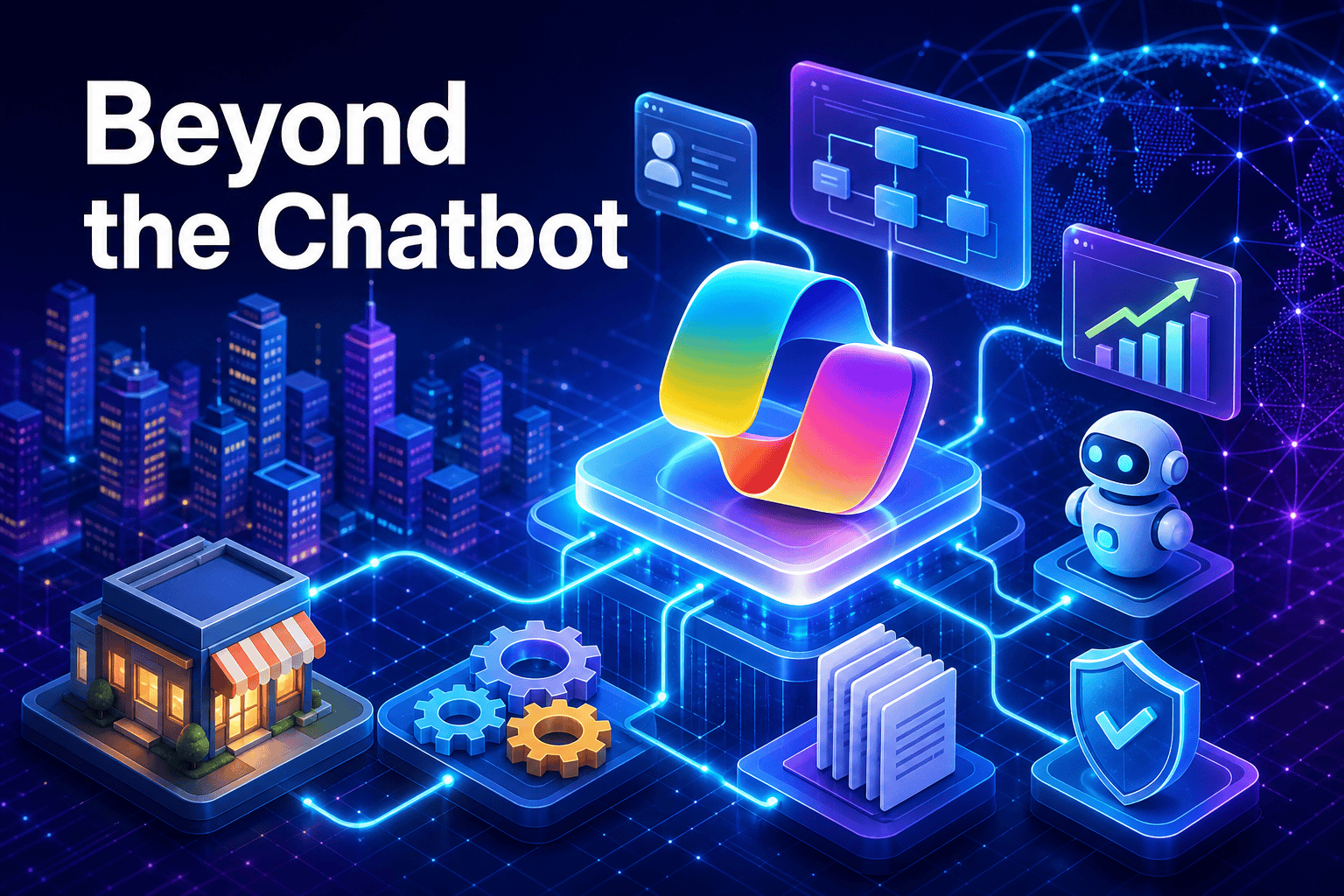
Microsoft has unveiled Copilot as a layer for building apps and automations inside companies, framing it almost like an AI operating system for work. That matters because it shows where the market is heading: away from one-off assistants and toward systems that can run parts of a workflow on their own.
For small and medium business owners, this is not just enterprise branding. It is a signal that the next wave of software will be organized around ai agents for business, with more automation across sales, support, and operations — and more attention on rising usage costs.
What Microsoft means by an AI operating system
In plain English, Microsoft is saying Copilot is no longer just a helper inside an app. It wants Copilot to be a shared layer where companies build internal tools, connect workflows, and let agents do work across systems.
That is a bigger ambition than a single ai agent platform for one department. The idea is that a sales flow, a support flow, and an operations flow can all sit on the same AI layer, drawing on company data and triggering actions without constant manual handoffs.
For enterprise buyers, that sounds like strategic infrastructure. For SMB owners, the useful takeaway is simpler: vendors are moving from “ask AI a question” to “let AI help move work forward.”
Why this is bigger than a chatbot
Many business owners still meet AI through a chat window, so it helps to separate a basic bot from an agent-driven workflow. An ai agent vs chatbot comparison is not about hype; it is about whether the system can only answer or whether it can also take the next step.
A chatbot may answer a product question from a knowledge base. An agent can answer, qualify the lead, create a task, update a CRM record, or pass the issue to the right person with context attached. That is why Microsoft is pushing beyond simple assistance and toward ai automation for small business and enterprise work alike.
| Approach | What it does | Best fit | Main limit |
|---|---|---|---|
| Chatbot | Answers common questions from a fixed source | Basic support and FAQ handling | Often stops at the conversation |
| Workflow agent | Reads context, follows rules, and triggers actions | Lead qualification, support triage, task creation | Needs clear access to business tools |
| AI operating layer | Supports multiple agents, apps, and automations across teams | Broader company workflows | Can add complexity and cost |
The real shift is not from software to magic. It is from isolated tools to connected workflows where AI can read, decide, and act inside the systems your business already uses.
The opportunity is real, but so is the cost question
The news also highlights an important concern: usage costs are rising. That matters because agent-driven software tends to do more than a single chat exchange, which can mean more model usage, more tool calls, and more layers in the bill.
For larger companies, that may be an acceptable tradeoff if the workflow is central enough. For smaller firms, cost discipline matters more than big-platform language. A system that looks impressive in a demo can become hard to justify if pricing scales with every conversation, action, or connected tool.
Before you commit, ask vendors questions like these:
- What exactly increases cost: users, messages, actions, models, or integrations?
- Can you limit where the agent acts on its own and where it only suggests?
- How do you monitor mistakes, approvals, and handoffs?
- Can you start with one workflow before rolling the system across the business?
This is where the market will split into two camps: platforms that are practical to start small with, and platforms that assume enterprise-scale budgets from day one.
How smaller companies can use the same trend without overbuilding
You do not need an enterprise stack to benefit from this shift. In many cases, the best starting point is ai agents without coding focused on one repeatable workflow: handling incoming questions, qualifying new leads, assigning tasks, or helping staff find answers from internal documents.
That is also where mcp servers become useful. In practical terms, they make it easier to connect assistants to business tools, which helps you connect ChatGPT to business tools or let Claude work with your systems without custom one-off integrations every time.
For example, a smaller business might start with an AI front desk on a website chat widget or Telegram, connect it to a lightweight CRM, and then add simple workflows for lead capture or support routing. Platforms such as botb2b.ai reflect that approach with an AI front desk for your website chat widget and Telegram, a free CRM with task boards, a catalog of AI models, and MCP servers that connect AI assistants to business tools — all without hiring a developer.
The broader lesson is not to buy the biggest platform. It is to choose the smallest workable system that can grow with you. That usually gives you faster learning, cleaner processes, and fewer surprises in your monthly bill.
What this means for your business
Microsoft’s move is a useful signal for any owner following business AI closely. The market is clearly moving toward AI as a workflow layer, not just a chat feature. That will shape how software is sold, how teams work, and how buyers compare tools over the next few years.
You do not need to copy an enterprise roadmap. What matters is choosing one business process where AI can free up time, keep responses consistent, and reduce manual switching between tools. Good candidates include first-contact support, lead qualification, internal task handoff, and document-based answering.
If you are evaluating an ai employee for business or a broader AI layer, keep your checklist simple:
- Start with one workflow that already happens every day.
- Make sure the agent can read the right data and act in the right tool.
- Test pricing under real usage, not just a demo.
- Prefer systems that can expand from one workflow into a wider AI setup when you are ready.
That is the practical takeaway from Microsoft’s Copilot push. The future may look like an AI operating system, but the smart SMB move is still the same: solve one real workflow well, then build outward.