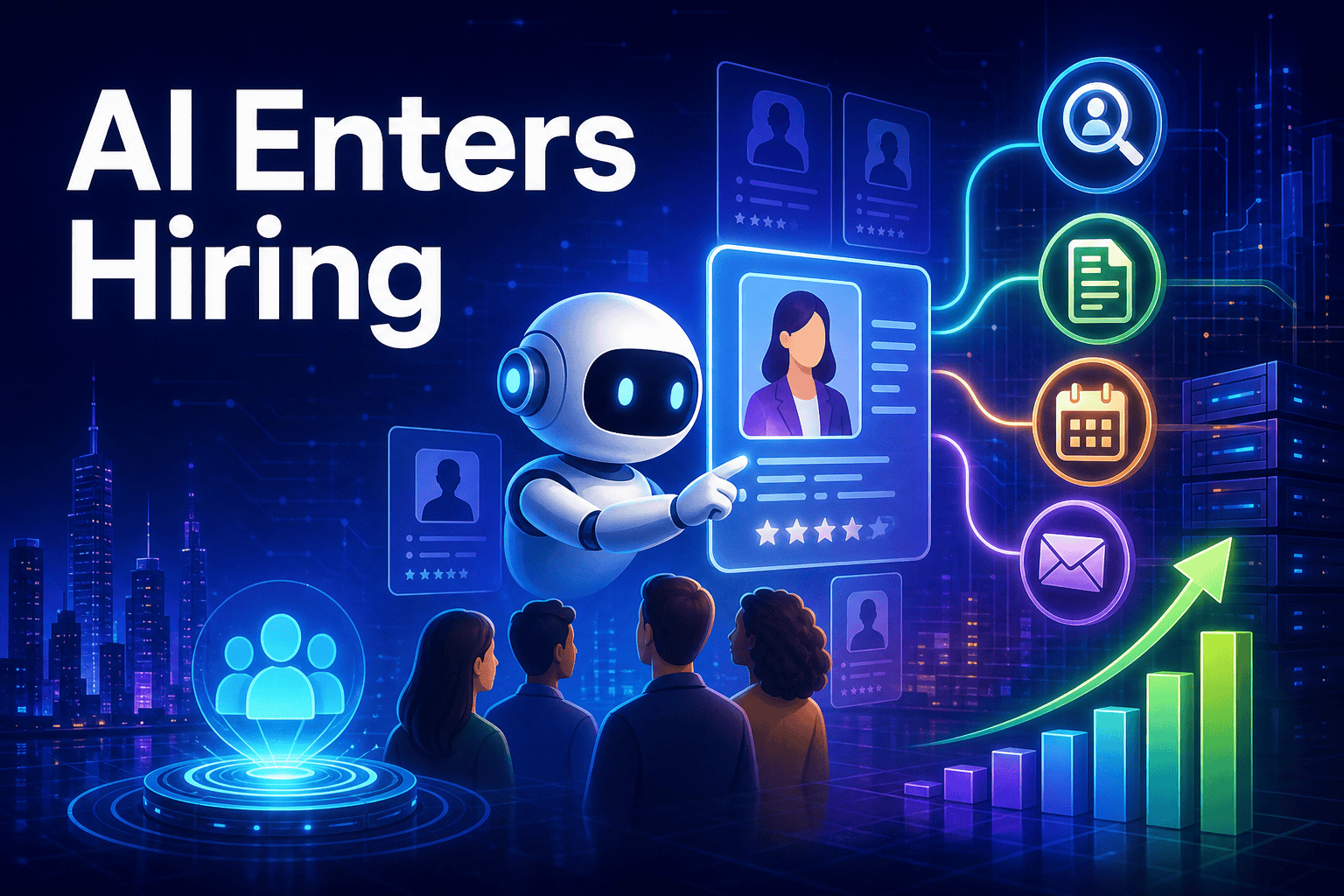
On September 24, Paychex introduced WISE Hire, an AI-powered recruiting platform designed to automate candidate sourcing and routine hiring tasks. For business owners, the headline is bigger than HR software. AI agents for business are moving beyond chat and into real workflows, which means more everyday admin can be handled with less manual chasing.
What Paychex actually launched
According to the announcement, WISE Hire brings agent-based automation into recruiting. Candidate sourcing and routine hiring tasks are exactly the kind of work AI handles well because they follow a process and happen again and again.
That matters because hiring is rarely just one decision. It is a chain of repeatable actions before and after the decision: gathering information, organizing it, keeping the process moving, and making sure nothing gets lost between steps.
For smaller companies, those steps are often handled by owners, office managers, or team leads who already wear too many hats. Every hour spent on administrative follow-up is an hour not spent on customers, delivery, or growth.
Why this is bigger than HR
Many owners still think of AI as a writing tool or a basic support bot. But AI automation for small business is shifting toward multi-step operational work, where software is expected to do more than answer a question.
This is where the AI agent vs chatbot difference becomes practical. A chatbot responds inside one conversation. An agent can follow rules, keep context, and help move a job from one stage to the next.
| Tool style | What it mainly does | Best fit |
|---|---|---|
| Chatbot | Answers questions inside one conversation | Basic FAQs and first response |
| AI agent | Follows steps, uses context, and advances a workflow | Recruiting, lead handling, internal routing |
| Connected AI system | Works across chat, tasks, CRM, and documents | Operations where handoffs matter |
The deeper message in the Paychex launch is simple: once a workflow has clear steps and clear handoffs, businesses will expect AI to handle the repetitive parts of it.
Once you see recruiting through that lens, the Paychex move makes sense. HR is simply another business function with clear handoffs, repetitive steps, and a need for consistency.
What an AI agent for small business should do first
If you run a lean company, do not start by trying to automate an entire department. Start with one AI agent for small business use case where the inputs are clear and the work repeats every day.
The best starting point is usually a process that creates friction but does not require deep judgment on every step. That is why owners often begin by trying to automate routine tasks with AI around inquiries, follow-ups, internal requests, or hiring admin.
When people talk about AI employees, the useful interpretation is not replacement. It is coverage: software handling the predictable parts so your team can focus on exceptions, approvals, and real conversations.
- Clear inputs such as forms, website messages, or email requests
- Clear next steps such as tagging, routing, or creating a task
- Clear human checkpoints for decisions, approvals, and edge cases
If a process changes completely every time, it is probably not the best first candidate. If it follows a mostly similar path, it is usually a strong fit for agent-based automation.
Connection is the real advantage
An agent becomes far more useful when it can access the right documents and update the right system. That is why MCP servers are becoming important for teams that want to connect ChatGPT to business tools instead of adding another isolated app.
Without connection, an assistant may give a nice answer but leave the real work untouched. With connection, it can carry context from a conversation into a task board, a CRM record, or an internal workflow so people do not have to copy and paste everything by hand.
This is also why many SMB owners are looking beyond one-off bots toward platforms. On botb2b.ai, for example, businesses can set up AI employees including an AI front desk for a website chat widget and Telegram, use a free CRM with task boards, choose from a catalog of AI models, and add MCP-based connections without hiring a developer.
The broader lesson is simple: connected AI is usually more valuable than clever AI. If the tool cannot fit your actual process, it stays a demo instead of becoming part of daily operations.
What this means for your business
You do not need to run a recruiting-heavy company to learn from the Paychex launch. AI agents for business are becoming workflow tools, and that opens practical options for teams that want less admin overhead and smoother handoffs.
If you are deciding where to begin, look for work that is repetitive, rules-based, and easy to observe. That is where an AI agent for small business usually delivers the clearest operational value.
- Pick one workflow that drains time every week.
- Define which steps the agent can handle and where a person must approve.
- Make sure the agent can reach the documents, tasks, or records it needs.
- Review the workflow regularly and improve the process, not just the prompt.
WISE Hire is a good signal of what comes next. The market is moving from simple chat experiences toward software that can own parts of a process, and businesses that prepare now will be in a better position to use AI calmly, usefully, and without unnecessary complexity.