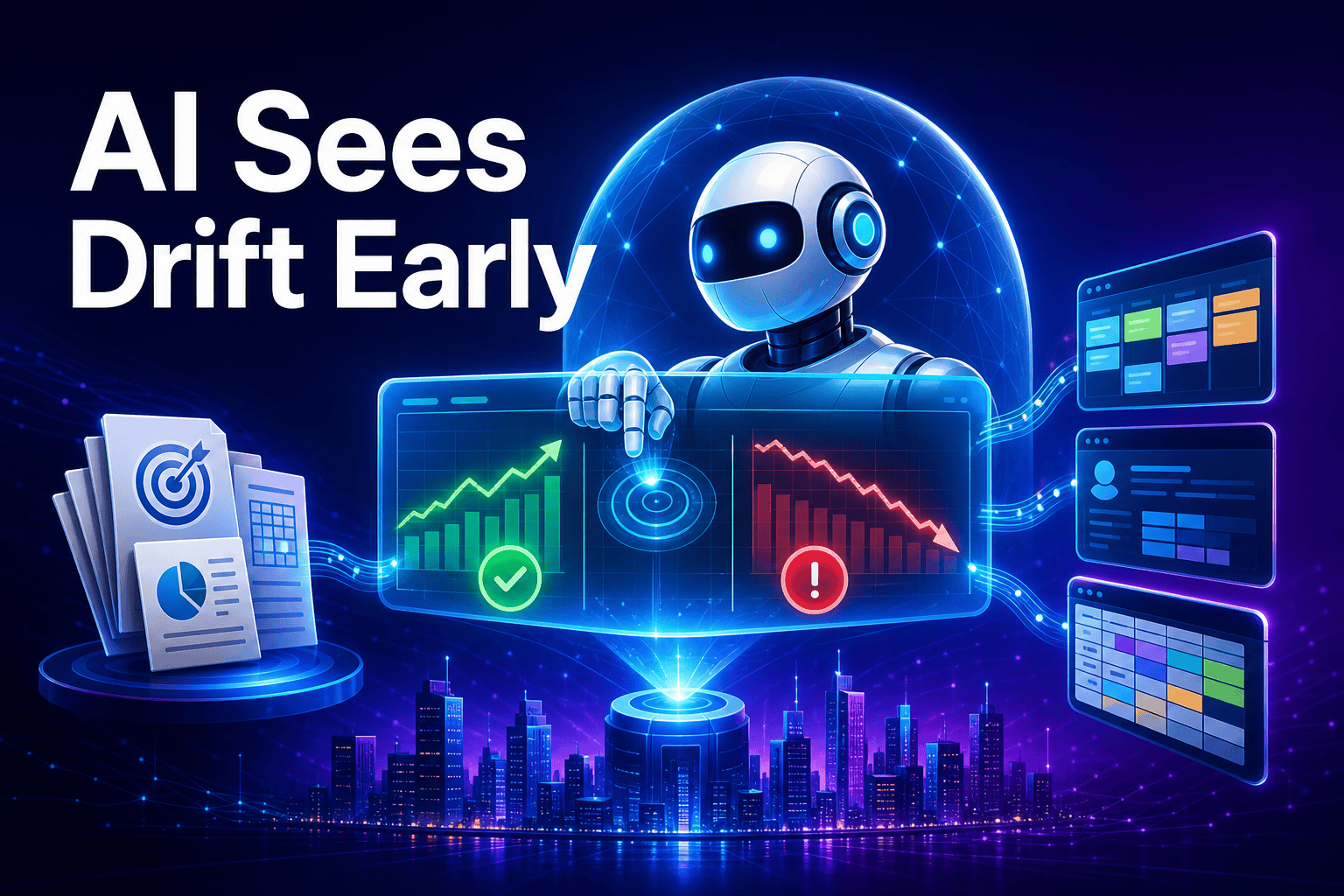
Smartsheet has launched vsActual, a standalone AI-powered platform announced at its Engage conference. It reads strategy documents and budgets, then tracks work across systems such as Jira, Workday, and Slack to flag when execution starts drifting away from the plan.
That matters even if you run a much smaller company. This is one of the clearest signs that ai agents for business are moving beyond chat and note-taking into something more useful: watching how work flows across tools and comparing it with what the business actually wants to achieve.
What Smartsheet launched with vsActual
vsActual stands out because it is a standalone AI platform, not just another feature inside Smartsheet's main product. According to the launch details, it does not require Smartsheet itself, which makes it a bigger strategic move than a typical add-on.
The platform uses AI agents to read company strategy and budgets, monitor work across connected systems, and warn leaders when projects are veering off course. Smartsheet says it can also generate executive reports and recommend adjustments as priorities change.
Under the hood, the company is leaning on what it calls an Execution Graph, built from 20 years of workflow data, millions of projects, and nine petabytes of information. It also connects through APIs and the model context protocol, which helps agents work across enterprise tools instead of staying locked inside one app.
There is a commercial signal here as well. Smartsheet is shifting toward consumption-based pricing rather than relying only on per-seat licenses, which reflects a world where software is used not just by employees, but by automations and agents too.
Why this matters beyond the enterprise
Most small and mid-sized businesses are not about to buy a heavyweight strategic execution layer. But the launch shows where ai trends for small business are heading: away from isolated copilots and toward cross-tool visibility that links plans, budgets, and daily work.
In simple terms, the next useful wave of AI is not only about answering a question faster. It is about helping owners and managers see whether sales, hiring, delivery, and support are all moving in the same direction.
| Signal from vsActual | What it means | Practical SMB takeaway |
|---|---|---|
| Reads strategy documents and budgets | AI is moving closer to business context, not just task help | Give your systems clear goals, process notes, and current priorities |
| Tracks work across Jira, Workday, Slack, and more | Value comes from seeing activity across tools | Connect your CRM, support flow, project board, and knowledge base first |
| Uses AI agents plus human approval | Automation works best with oversight | Keep approvals for sensitive changes and escalations |
| Connects through APIs and MCP | Open systems beat forced platform consolidation | Choose tools that can share context with assistants and automations |
The big lesson is simple: AI becomes far more useful when it can see your business across tools, not only inside one chat window or one app.
AI agent vs chatbot: why MCP matters
If you are comparing an ai agent vs chatbot, this news makes the difference easy to see. A chatbot can answer messages inside one interface, but an agentic system can read business context from multiple tools, understand what is happening, and suggest the next action.
That is why the model context protocol matters so much. Along with APIs, it gives businesses a standard way to let assistants access the right context, which is exactly what you need if you want to use connect chatgpt to business tools in a practical way instead of treating AI as a disconnected helper.
Smartsheet's design choice is also worth noting. Its team says some workflows can run automatically, but consequential actions still stay human-in-the-loop by default, and the product combines conventional automation with AI instead of forcing every step through a large language model. That is usually a healthier setup for real operations.
How smaller teams can use the same idea
You do not need a giant knowledge graph or nine petabytes of history to borrow the logic behind vsActual. For most companies, ai automation for small business starts with a smaller loop: set one goal, connect the tools involved, let AI monitor routine activity, and keep people in charge of final decisions.
A practical starting point often looks like this:
- Define one business outcome that matters right now, such as faster follow-up, cleaner handoffs, or fewer support bottlenecks.
- Connect only the systems that shape that outcome, usually your website chat, CRM, task board, and internal documentation.
- Let AI handle first-line questions, tagging, summaries, and reminders before you ask it to manage higher-stakes actions.
- Review what the system flags every week so the workflow improves with real business feedback.
This is where many owners are finding value in ai employees and lightweight agent workflows rather than large enterprise platforms. For example, botb2b.ai is an international platform with AI employees, including an AI front desk for your website chat widget and Telegram, a free CRM with task boards, a catalog of AI models, and mcp servers that connect AI assistants like Claude and ChatGPT to business tools without hiring a developer.
The important point is not to copy Smartsheet's scale. It is to copy the operating principle: keep business context connected, let AI handle routine signals, and make sure important actions stay visible to a human.
What this means for your business
Smartsheet's launch is not just another product announcement. It is a sign that business AI is moving from isolated helpers toward a more connected operating layer, where systems can observe work across departments and tools, then surface problems earlier.
For an SMB, that does not mean buying enterprise software built for a global operations team. It means asking better questions about your own stack: which tools hold your customer conversations, tasks, documents, and decisions, and how easily can they share business context with AI?
If you are evaluating new AI software, these are the questions worth asking first:
- Can this tool see the context it needs, or is it trapped inside one interface?
- Does it support human review for important actions?
- Can it work with the systems I already use instead of forcing a full migration?
- Will it help me spot drift between my plan and my day-to-day execution?
The smartest next step for most owners is small but strategic. Connect a few core tools, define one clear workflow, and use AI to surface the gap between plan and reality earlier. That is where the next real advantage in business AI is forming.