TurboAgents launches as a connected marketing system
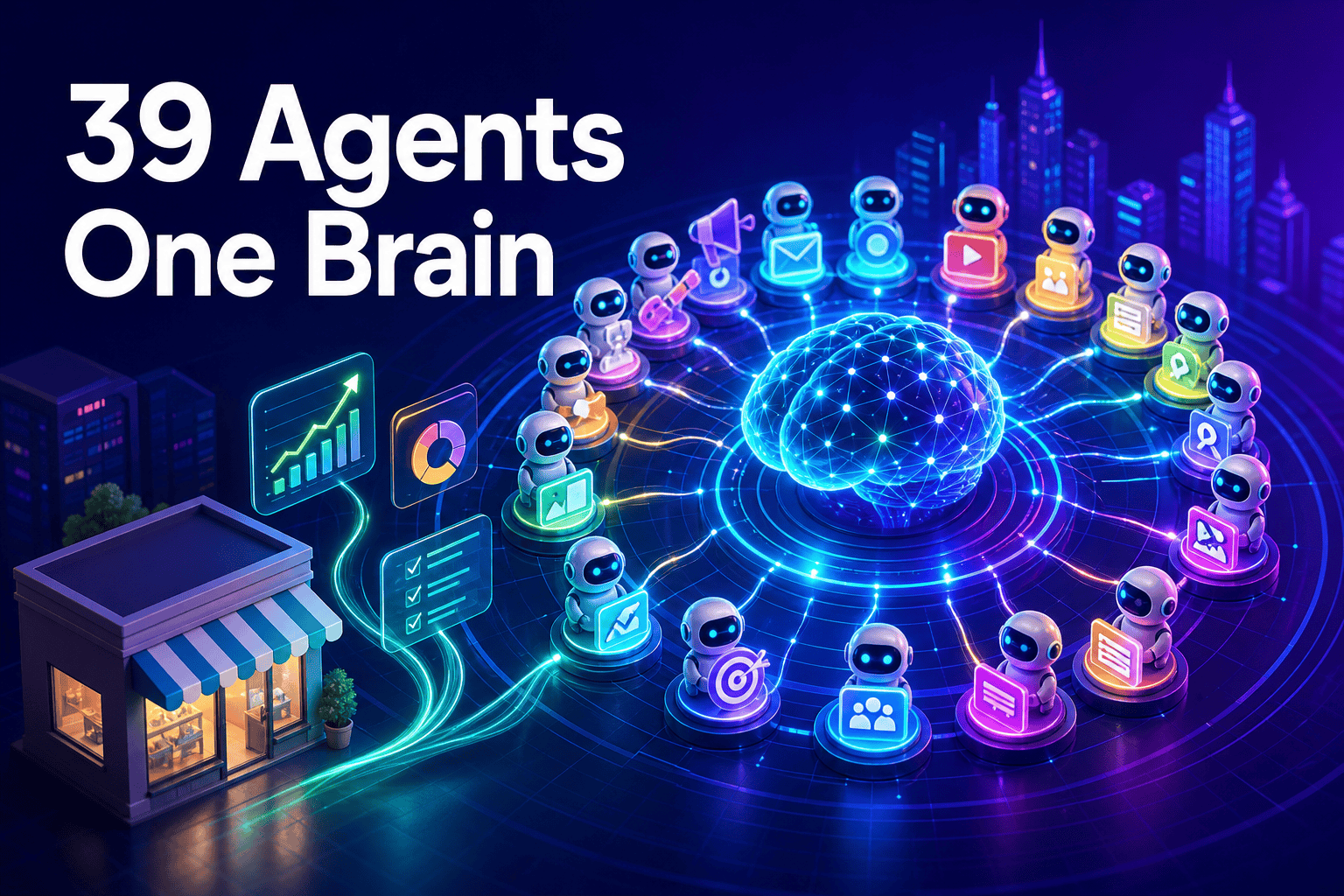
This week, TurboAgents launched as a global AI-powered marketing platform built for small businesses, founders, D2C brands and boutique agencies. The headline feature is 39 specialized AI agents spread across seven functions, with a centralized brand system called Brand Brain designed to keep strategy, content and execution aligned.
According to the announcement, TurboAgents is meant to help smaller teams plan, create and execute marketing without building a large in-house department. Its agents cover strategy, creative, social media, ecommerce, video, SEO and productivity, while a Workflow Builder connects those pieces into end-to-end processes.
That matters because most businesses do not struggle to find AI tools anymore. They struggle to turn separate tools into one usable process. In that sense, this is more than a product launch. It is a useful piece of AI news for business because it shows where the market is moving: away from one-off generators and toward AI agents for business that share context.
Why this matters to any small business using AI tools
Many owners already use a writing tool, an image generator, maybe a research assistant, and perhaps something for campaign setup. The problem is that every tool often starts from scratch. Your team repeats the same brand briefing, rewrites the same product explanation, and still ends up with inconsistent output.
TurboAgents is trying to solve that with Brand Brain, which analyzes a business website and builds a profile around brand identity, products, target audience and competitive landscape. Whether you call that memory, context or brand intelligence, the point is simple: shared business context is what turns scattered prompts into AI automation for small business.
| What TurboAgents announced | Why it matters |
|---|---|
| 39 agents across 7 marketing functions | Shows a role-based approach instead of one general tool |
| Brand Brain built from website analysis | Reduces repeated briefing and helps keep outputs consistent |
| Workflow Builder | Connects research, planning, creation and execution in one process |
| Ready-to-use outputs | Aims to deliver work products, not just ideas or drafts |
| 48-hour free trial and plans from US$49 to US$2,499 | Creates an entry point for solo users, small teams and agencies |
For a small business owner, the big takeaway is not the number 39 by itself. It is the idea that AI becomes more useful when it works like a coordinated system, not a bag of disconnected apps.
The important shift is not from people to robots. It is from isolated AI prompts to connected workflows that keep the same brand memory from planning through execution.
From one-off tools to an AI workforce
When people search for an AI agent platform, they usually are not looking for another chatbot window. They want software that can take on repeatable parts of real work: researching a market, drafting campaign angles, preparing ecommerce listings, or packaging assets for launch. That is why launches like TurboAgents are better understood as early examples of a digital workforce for a specific function.
This is also why the term AI employees keeps gaining attention. Not because businesses want to replace everyone, but because owners want dependable systems that free up time, preserve context and help lean teams move faster. A marketing business may need creative and campaign support; another company may need first-line coordination in support, sales or operations. The pattern is the same.
Still, there is a practical limit to every AI workforce idea. If the underlying data is weak, the workflows are messy, or nobody reviews the outputs, even a large set of agents will not feel helpful. The strongest part of TurboAgents’ positioning is not “more AI.” It is the promise of a more disciplined process around the AI.
What smaller teams should copy from this model
You do not need 39 agents to learn from this launch. Even if you use other tools, there are a few smart principles in this setup that most small teams can apply right away.
- Create one source of truth first. Before you automate anything, gather your core brand, product and audience information in one place.
- Automate a workflow, not a task. A content draft is useful, but a connected flow from brief to publish-ready asset is more valuable.
- Use role-based AI where it helps. Separate strategy, research, creative and execution if those jobs need different prompts and checks.
- Keep human approval in the loop. AI can prepare the work, but your team should still validate priorities, tone and final decisions.
- Prefer tools you can run without coding. For most owners, simple adoption beats technical complexity.
Beyond marketing: support, sales and operations
The same model matters outside marketing too. A business may start with an AI front desk on its website chat widget, then add AI customer support for repetitive questions, or use an AI sales agent for early AI lead qualification. The business value comes from connected context, clear handoffs and visibility inside your CRM.
That is where platforms like botb2b.ai fit naturally into the broader trend. It is an international platform with AI employees, including an AI front desk for your website chat widget and Telegram, a free CRM with task boards, a catalog of AI models, and MCP servers that connect AI assistants like Claude and ChatGPT to business tools without hiring a developer. For many SMBs, that is the practical path: AI agents without coding, tied to real workflows your team already runs.
What this means for your business
The TurboAgents launch is a clear sign that the market is maturing. Businesses are no longer impressed by AI that can only generate one asset at a time. They want systems that remember the business, coordinate tasks and produce outputs people can actually use.
If you run a small or mid-sized company, the immediate lesson is straightforward:
- Audit where your team repeats itself. Look for places where the same context gets re-explained across tools or people.
- Choose one workflow to improve first. Marketing is one option, but support, lead handling and internal operations are often easier starting points.
- Pick connected tools over crowded tool stacks. The best AI tools for SMB are usually the ones your team can adopt quickly and use consistently.
You do not need a giant department to work in a more structured way. What you need is a system that understands your business, supports your team and reduces routine friction. That is the real message behind TurboAgents, and it is likely the direction more AI agent for small business products will follow next.