Toast has launched a new set of AI agents for restaurant operations and said they sit inside a broader agentic platform built to automate difficult workflows. On the surface, that looks like restaurant technology news. In practice, it is a useful signal for any owner watching AI agents for business: the market is moving beyond tools that only answer questions and toward tools that can help move work forward.
For small and mid-sized companies, that matters because the real value of AI rarely comes from novelty. It comes from whether an ai agent platform can reduce repetitive admin, speed up replies, and keep routine tasks from bouncing around your team all day.
What Toast announced, in plain English
According to the news, Toast introduced multiple AI agents for restaurants and framed them as part of a wider platform for automating hard restaurant workflows. The important phrase here is not only AI agents. It is agentic platform, which suggests a system where different agents are assigned to specific jobs instead of one generic bot trying to do everything.
That matters because restaurant software is operational software. When a vendor in that category starts packaging AI into workflows, it usually means customers want help with time-sensitive tasks that repeat every day. In other words, the focus is shifting from AI as a feature to AI inside real operations.
- It is being positioned around workflow automation, not entertainment.
- It is aimed at difficult, messy tasks where staff time gets fragmented.
- It shows that vertical software vendors expect AI to live inside the tools businesses already use.
Why this is bigger than restaurants
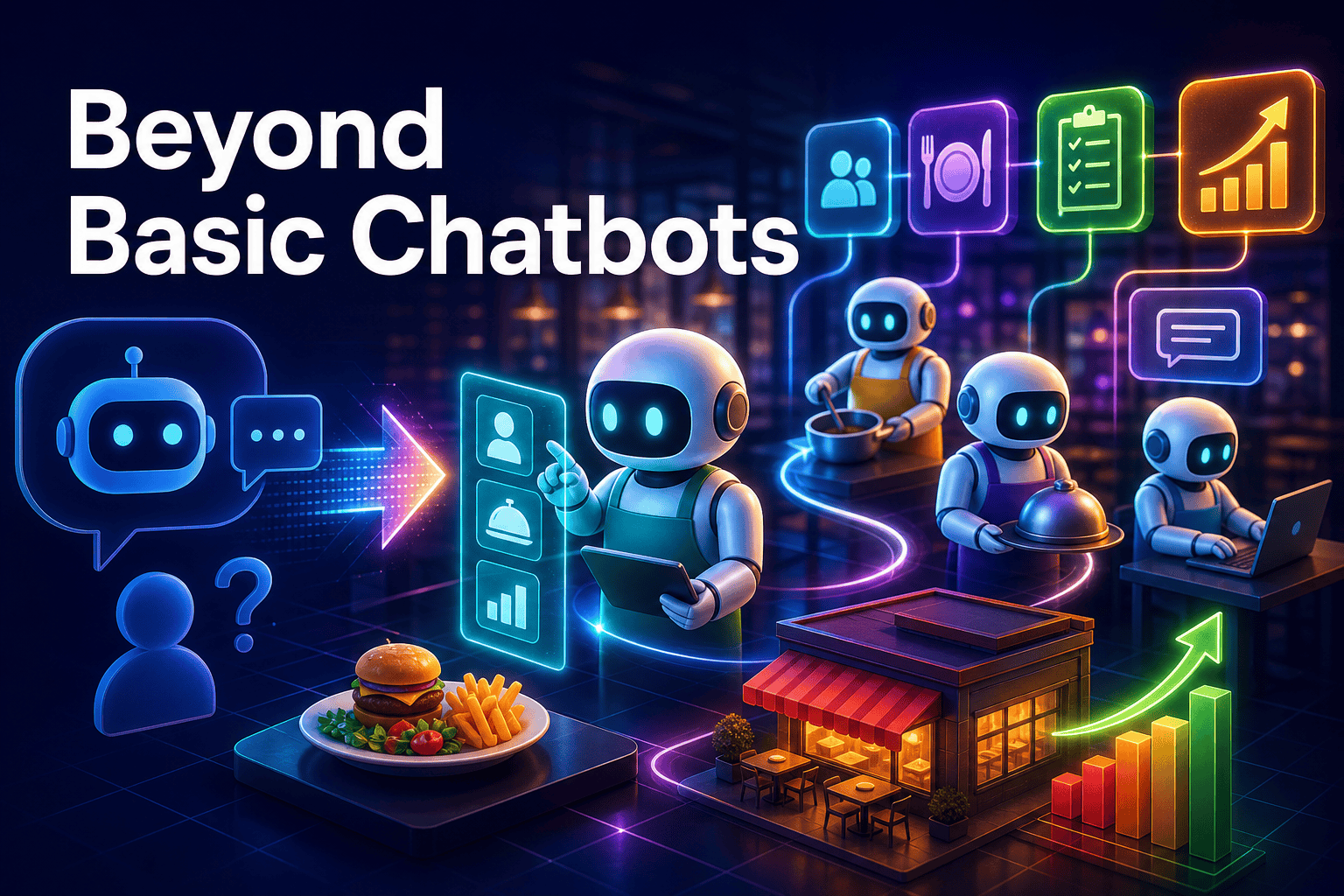
Many owners still think in terms of ai agent vs chatbot. That is a useful distinction. A basic chatbot is mostly an answering layer. An AI agent can be designed to follow steps, pull context from documents or systems, and prepare the next action in a workflow.
| Question | Basic chatbot | AI agent | Why it matters |
|---|---|---|---|
| Can it answer common questions? | Usually yes | Yes | Faster first response |
| Can it follow a multi-step process? | Often limited | More likely by design | Less manual back-and-forth |
| Can it use business context? | Sometimes | Usually a core requirement | More relevant outputs |
| Can it work across tools? | Rarely | Possible when connected well | Fewer copy-paste tasks |
Capabilities vary by product, and not every tool labeled agent can actually do much. But the direction is clear: businesses want software that does more than generate text. They want systems that help move the next task forward in ways that are visible and controllable.
The real shift is not that software can talk better. It is that more businesses can now ask software to take the next step in a process, not just describe it.
What to look for in an AI agent platform
If this news makes you curious, resist the urge to buy the biggest promise on the market. For most owners, the best starting point is AI agents without coding that solve one narrow problem well, then expand only after the workflow is stable.
- Start with one use case, such as handling common website questions or turning inbound chats into structured follow-up tasks.
- Make sure the agent uses approved business knowledge, not random guesses.
- Check how humans review, edit, or take over edge cases.
- Ask how the system connects to the tools where work already lives.
This is where MCP servers start to matter. Model Context Protocol is becoming a practical way to help AI assistants work with business tools more cleanly, instead of forcing owners into brittle one-off setups.
If you want to test this direction without hiring a developer, platforms such as botb2b.ai package an AI front desk for your website chat widget and Telegram, a free CRM with task boards, a catalog of AI models, and MCP servers that connect assistants like Claude and ChatGPT to business tools. That does not remove the need for clear processes, but it lowers the barrier to trying an agent-based setup.
Where smaller businesses can use this first
You do not need a restaurant chain to benefit from the same idea. The best first use cases are repetitive, high-volume, and easy to define. That is why AI customer support and front-desk workflows are often the first place owners see value.
- Website front desk: answer common pre-sales and service questions from approved information, then collect context before a human jumps in.
- Support triage: sort routine requests, clarify the issue, and hand off cases with cleaner notes.
- Operations help: turn repeat questions about policies, documents, or checklists into fast answers for staff.
- Sales follow-up: capture the key details from an incoming conversation and place them where the team can act.
The point is not to remove humans from every step. It is to use AI where the work is repetitive and clearly defined, so your team can spend more time on exceptions, judgment, and customer relationships.
What this means for your business
Toast’s announcement is a reminder that AI adoption is entering a more practical phase. Instead of asking whether AI is good or bad, owners should ask which workflow is slow, repetitive, and easy to define. That is the right place to test AI employees as narrow helpers rather than as magic replacements for your team.
- Pick one workflow with clear boundaries, such as first-response support or lead intake from your site.
- Decide what information the agent can safely use and where a person must review the result.
- Keep the connection to your existing tools simple, so work does not disappear into another silo.
- Review conversations, tasks, and exceptions every week before expanding to a second workflow.
If Toast’s move tells the market anything, it is this: businesses do not just want AI that talks well. They want AI that fits into operations. For small and medium-sized companies, that is good news, because the winners are likely to be the tools that are practical, understandable, and possible to launch without a long custom build.