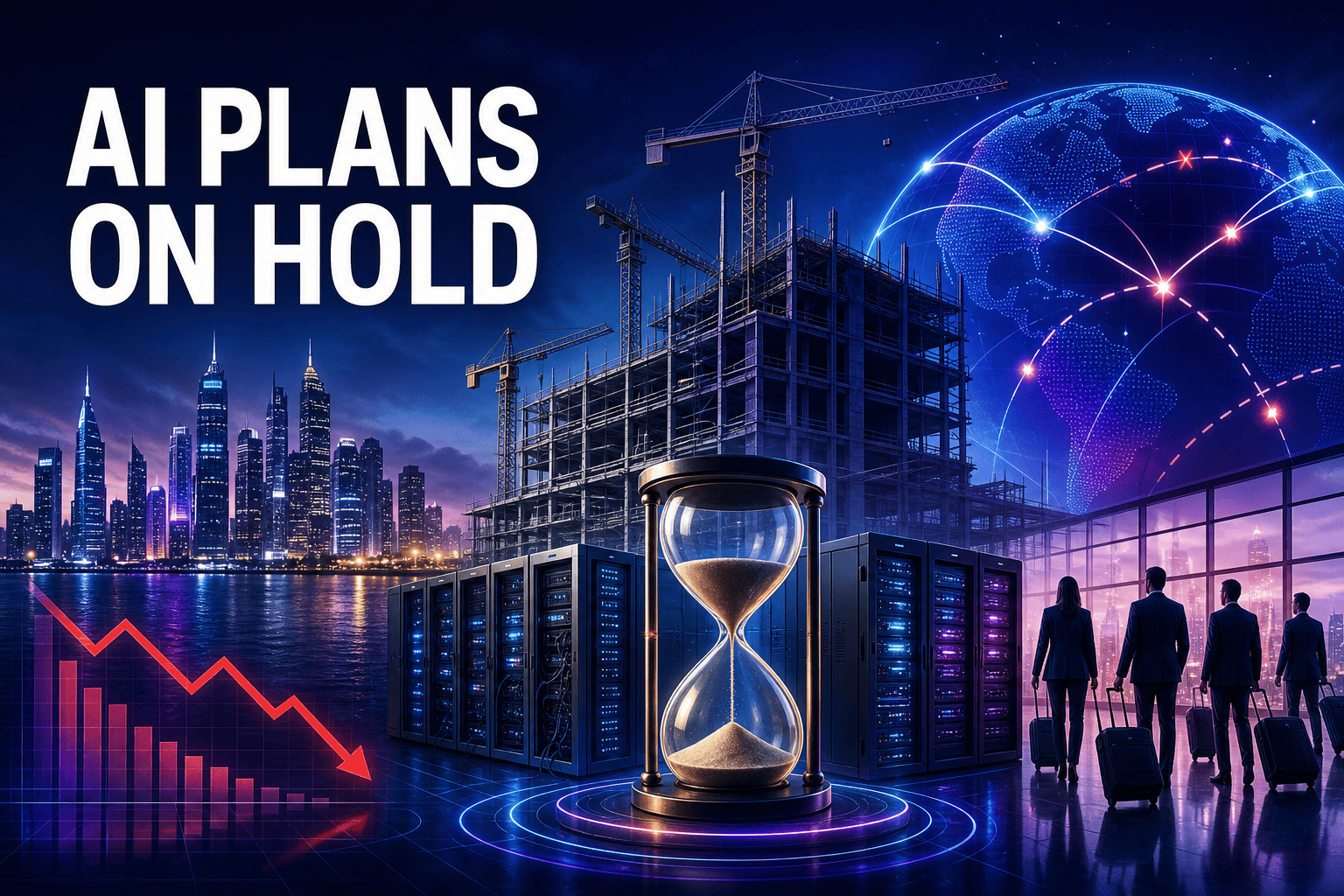
Geopolitical tensions around Iran have directly complicated Abu Dhabi’s long-term strategy to position itself as the region’s premier artificial intelligence center. Recent developments have slowed partnerships, talent inflows, and infrastructure projects that were central to those ambitions.
Deutsche Welle reported that the conflict’s ripple effects are forcing Abu Dhabi to reassess timelines and risk exposure in its AI roadmap. The coverage highlights how security concerns and shifting alliances now affect everything from data-center construction to research collaborations.
These events arrive at a moment when governments and corporations across the Gulf are racing to integrate advanced AI systems. Supply-chain uncertainty, restricted movement of specialists, and tighter financing conditions have all become immediate constraints.
While headline announcements about national AI strategies continue, execution risk has risen sharply. Companies that had counted on stable regional AI ecosystems must now build internal resilience rather than rely solely on external hubs.
What Happened
The core issue is straightforward: security dynamics tied to the Iran situation have increased operational friction for Abu Dhabi’s AI initiatives. Foreign partners are applying extra scrutiny to travel, data-sharing agreements, and long-term commitments.
Projects that once moved on accelerated schedules now face additional layers of compliance and contingency planning. This is not a complete halt, but a measurable slowdown in momentum.
Why This Matters Now
Businesses everywhere are watching how geopolitical events can suddenly alter access to AI talent, compute resources, and vendor ecosystems. The Middle East has been viewed as an emerging stable zone; any perception shift changes investment calculations.
At the same time, day-to-day commercial operations cannot pause. Sales pipelines, advertising campaigns, CRM hygiene, and employee reporting must continue regardless of external shocks.
Business Impact
Organizations that depend on regional AI partnerships are reassessing single-point dependencies. The practical consequence is renewed focus on internal automation that does not require proximity to specific innovation clusters.
Leaders in sales and operations are prioritizing tools that keep lead qualification, campaign adjustments, and cross-team coordination running smoothly even when external conditions deteriorate.
AI Automation and AI Manager Use Cases
An AI manager can absorb routine coordination tasks that would otherwise require constant managerial attention. This includes routing qualified leads to the right sales agent and updating CRM records without manual entry.
An AI front desk on the website chat widget and Telegram lets teams keep answering inbound demand when market signals change, so no enquiry is lost during periods of uncertainty.
Teams juggling several inbound channels benefit from a shared CRM with task boards, where every conversation lands as a lead with its context, reducing the time spent on repetitive manual data entry.
An AI CRM manager keeps customer data clean and triggers follow-up sequences automatically, supporting higher response speed and better lead processing even when staff capacity is stretched.
Sales agents and operations assistants handle initial qualification and task tracking, freeing human managers to focus on high-value decisions. Employee reporting agents consolidate daily updates across departments, improving coordination without additional meetings.
Risks and Opportunities
The primary risk is over-reliance on external AI ecosystems that can be disrupted by events beyond a company’s control. The corresponding opportunity lies in deploying AI agents for business that operate inside existing workflows and deliver measurable gains in conversion and reduced manager workload.
Companies that implement sales automation with AI and team workflow automation now position themselves to sustain performance regardless of macro-level turbulence in AI development hubs.