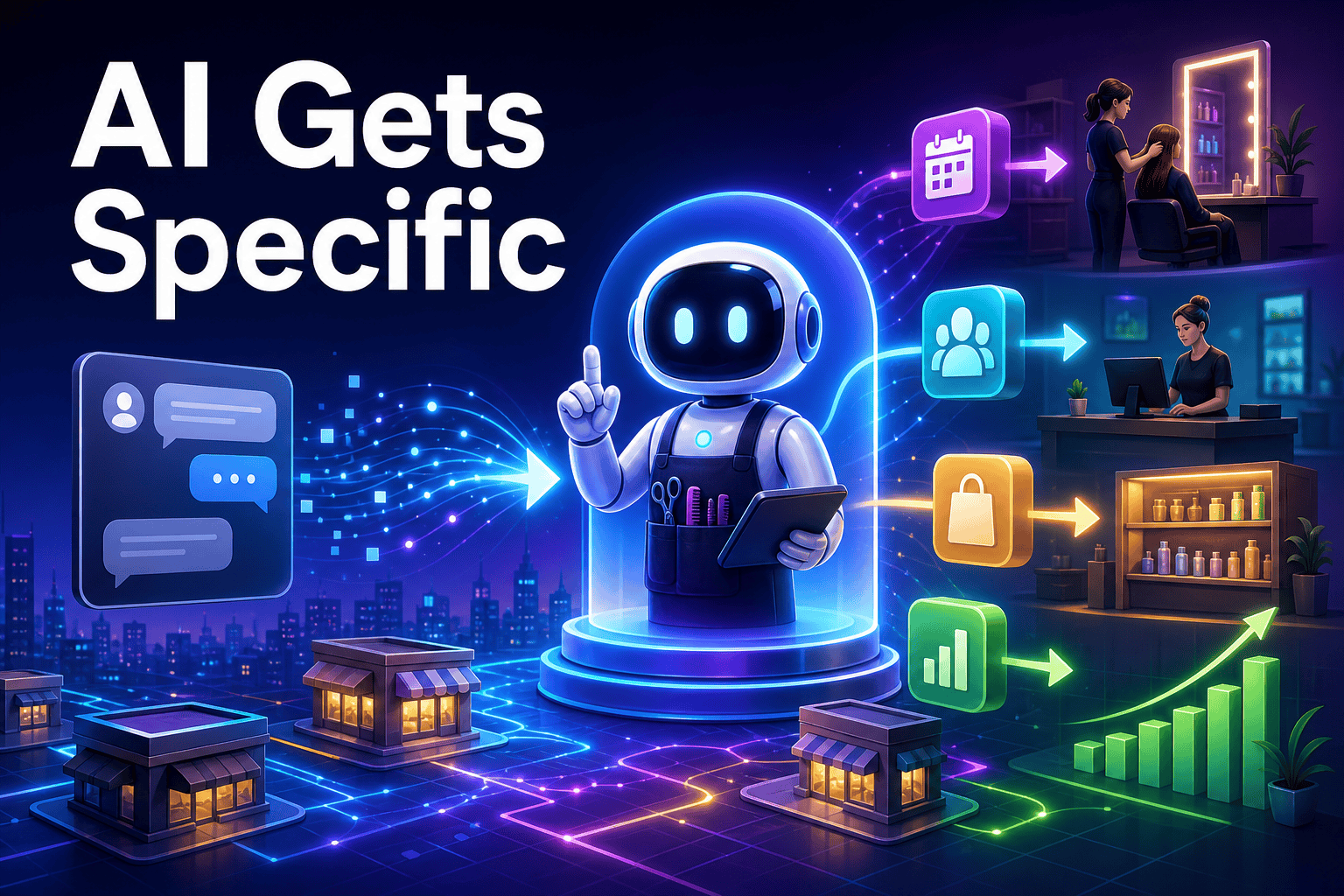
Meituan has launched an AI assistant for hairstylists. The tool is meant to help salon professionals answer operational questions, analyze business data, and publish their work online.
That may sound like a niche update, but it points to a broader shift. Small businesses are moving past general AI demos and toward role-specific AI that supports daily work inside the business.
What Meituan actually launched
Based on the announcement, this assistant focuses on three practical jobs: answering operational questions, making sense of business data, and helping stylists publish their work online. In other words, it is positioned as a working tool for the salon, not just a text generator.
That distinction matters. Many owners do not lose time on one big task; they lose it on dozens of small decisions, repeated questions, and admin steps spread across the day. A focused assistant can help reduce that friction without changing how the whole business operates.
It also shows how an ai employee for business is increasingly being packaged around one role and one set of repeatable tasks. That is often where AI feels most useful to smaller teams: not everywhere at once, but somewhere very specific.
Why this matters beyond salons
A hair salon is only the surface example. The bigger story is that ai agents for business are becoming more vertical, more practical, and easier to explain in terms of day-to-day work.
Think about the same pattern in other companies. A clinic may want fast answers to internal process questions. A home services business may want quick summaries of performance numbers. A retailer may want help turning daily work into publishable updates. Different industries, same need: clear workflows that stop routine tasks from piling up.
For small and midsize businesses, that is good news. It is much easier to evaluate a tool when you can ask a simple question: does it help one person or one team do one recurring job better?
- Answer repeated internal questions
- Turn raw numbers into readable summaries
- Prepare online updates from existing work
- Keep staff focused on higher-value activity
The real change is not AI that can do a little bit of everything, but AI that is clearly responsible for one useful slice of work.
From general chat to task-focused assistants
Owners often hear news like this and assume it is just another chatbot. That misses the important part. A general chat tool can reply to prompts, but a task-focused assistant can support a real workflow with business context behind it.
The difference usually comes down to context and follow-through. Can the assistant answer based on your operating rules, your data, and your content? Can it help complete the next step, not just describe it?
| Approach | What it mainly does | Best use for an SMB |
|---|---|---|
| General AI chat tool | Generates ideas, text, and broad answers | One-off drafting and brainstorming |
| Role-focused assistant | Supports a defined job with business context | Operations, reporting, publishing, internal help |
| Connected assistant | Works with selected tools and live business information | Ongoing processes that need updates and action |
This is why many businesses are starting with narrow use cases first. A focused assistant is easier to test, easier for staff to understand, and easier for the owner to measure in practical terms.
How to evaluate this idea in your own company
If you want to apply the lesson from this launch, do not start by asking which AI model is fashionable. Start by mapping the repetitive work that slows your team down every week. That is usually the best place to introduce a small internal assistant.
- List the questions people ask again and again.
- Identify reports or numbers someone checks manually.
- Mark content tasks that depend on existing business information.
- Choose one process where faster answers would noticeably help.
After that, the next issue is access. Useful assistants need selected business context: documents, process notes, service details, and sometimes a connection to the tools where work is tracked. This is where mcp servers matter, because they help AI assistants work with business systems in a more structured way.
For owners, the practical question is simple: can the assistant work with the information your team already uses? If the answer is no, the tool may stay interesting but never become part of daily operations.
That is also why some businesses prefer a connected platform rather than stitching separate apps together. For example, botb2b.ai combines an AI front desk for your website chat widget and Telegram, a free CRM with task boards, a catalog of AI models, and MCP servers that connect assistants like Claude and ChatGPT to business tools without hiring a developer. Even if you choose another setup, the broader lesson is the same: practical AI adoption depends on context and connection, not just clever replies.
What this means for your business
Meituan's salon assistant is a reminder that the most valuable AI projects are often the least flashy. They do not try to replace your whole team. They help free up time by handling a narrow set of routine tasks that keep stealing attention.
If you run a small or midsize business, the opportunity is to start with one role, one repeating problem, and one useful data source. That could be internal Q&A, simple performance summaries, or turning completed work into online updates.
The businesses that benefit most from AI in the next phase are unlikely to be the ones chasing every headline. They will be the ones making practical adoption decisions, building small wins, and choosing assistants that fit the way their business already works.